




![Cordless Car Buffer Polisher kit [2X 2000mAh 21V Batteries & 18 PCS Attachments] 6-Speed Orbital Design, LED Display, Lightweight Detailing Tool for Waxing, Polishing & Scratch Removal-Yellow Yellow 21V](https://m.media-amazon.com/images/I/71DSNIY4FcL._AC_SL1500_._SL800_.jpg)
![Cordless Car Buffer Polisher kit [2X 2000mAh 21V Batteries & 18 PCS Attachments] 6-Speed Orbital Design, LED Display, Lightweight Detailing Tool for Waxing, Polishing & Scratch Removal-Yellow Yellow 21V](https://m.media-amazon.com/images/I/813NFZexUxL._AC_SL1500_._SL800_.jpg)
![Cordless Car Buffer Polisher kit [2X 2000mAh 21V Batteries & 18 PCS Attachments] 6-Speed Orbital Design, LED Display, Lightweight Detailing Tool for Waxing, Polishing & Scratch Removal-Yellow Yellow 21V](https://m.media-amazon.com/images/I/81P-tabeQPL._AC_SL1500_._SL800_.jpg)
![Cordless Car Buffer Polisher kit [2X 2000mAh 21V Batteries & 18 PCS Attachments] 6-Speed Orbital Design, LED Display, Lightweight Detailing Tool for Waxing, Polishing & Scratch Removal-Yellow Yellow 21V](https://m.media-amazon.com/images/I/81fJeU-+QJL._AC_SL1500_._SL800_.jpg)
![Cordless Car Buffer Polisher kit [2X 2000mAh 21V Batteries & 18 PCS Attachments] 6-Speed Orbital Design, LED Display, Lightweight Detailing Tool for Waxing, Polishing & Scratch Removal-Yellow Yellow 21V](https://m.media-amazon.com/images/I/8154NPOzkAL._AC_SL1500_._SL800_.jpg)
![Cordless Car Buffer Polisher kit [2X 2000mAh 21V Batteries & 18 PCS Attachments] 6-Speed Orbital Design, LED Display, Lightweight Detailing Tool for Waxing, Polishing & Scratch Removal-Yellow Yellow 21V](https://m.media-amazon.com/images/I/81Ok8bA7gDL._AC_SL1500_._SL800_.jpg)
Affiliate disclosure: This article contains affiliate links. If you purchase through these links, we may earn a commission at no extra cost to you.
Best Car Wax Buffers and Polishers: An Honest Buyer's Guide
A car buffer can transform paint that looks dull and scratched into something that looks like it just rolled off the dealer's lot. It can also, in untrained hands, burn through clear coat and create damage that costs hundreds to fix. The difference between these outcomes comes down to choosing the right tool for your experience level and using it correctly.
This guide reviews the best car wax buffers and polishers available on Amazon, from hand-application products to professional-grade machines. I'm direct about who each product is suited for, what speed and power levels mean in practice, and where each one falls short.
This is for anyone considering adding a buffer to their detailing toolkit, from beginners curious about their first orbital to enthusiasts who want a credible machine upgrade.
Quick Picks
| Product | Best For | Price | Rating |
|---|---|---|---|
| SPTA 5-Inch Dual Action Orbital (DAPSET-US) | First-time machine polishing | $99.44 | 4.6★ |
| Fanttik P10 Pro Mini Cordless Buffer | Tight spots and small panels | $69.99 | 4.7★ |
| Meguiar's Cleaner Wax (Liquid, 16 oz) | Hand waxing with light correction | $9.99 | 4.7★ |
| FONAROLL Microfiber Wax Applicator Pads (6 Pack) | Hand wax application | $6.99 | 4.6★ |
| Seesii 1600W Rotary Polisher | DIY correction work | $49.99 | 4.7★ |
Product Reviews
Meguiar's Cleaner Wax Liquid (16 oz)
Meguiar's Cleaner Wax is a one-step liquid that cleans paint while applying wax protection. It has 4,485 reviews at 4.7 stars and costs $9.99 for 16 oz.
Standout features: - One-step formula cleans surface contaminants and blemishes while applying wax protection - Rich conditioning oils produce a high-gloss shine - Safe on all glossy finishes including clear coat and single-stage paint
Starting this guide with a hand-application product is intentional. Not everyone needs a machine buffer. For cars in good condition with only minor swirl removal needed, a cleaner wax applied by hand (or with an applicator pad) is often sufficient and far lower risk than machine polishing.
Meguiar's Cleaner Wax combines mild abrasives for surface cleaning with carnauba wax for protection. The abrasives are gentle enough that they won't damage paint with proper hand application, but they're effective enough to address minor oxidation and light swirl marks.
At $9.99 for 16 oz, this is one of the best values in any detailing product category. The 4,485 reviews at 4.7 stars gives genuine confidence in consistent results.
The limitation is that hand application has less power than machine application. For deeper scratches, significant swirling, or heavily oxidized paint, a cleaner wax applied by hand won't be enough. You need a machine polisher with a cutting compound. But for routine maintenance and minor correction, hand application works and is safer for beginners.
Pros: - 4,485 reviews at 4.7 stars, proven track record - Under $10, exceptional value - One-step clean + protect reduces effort - Safe for beginners with no equipment requirements
Cons: - Hand application has limited cutting power for heavy paint correction - 16 oz runs out quickly if waxing multiple vehicles - Liquid formula requires a good applicator pad for even distribution
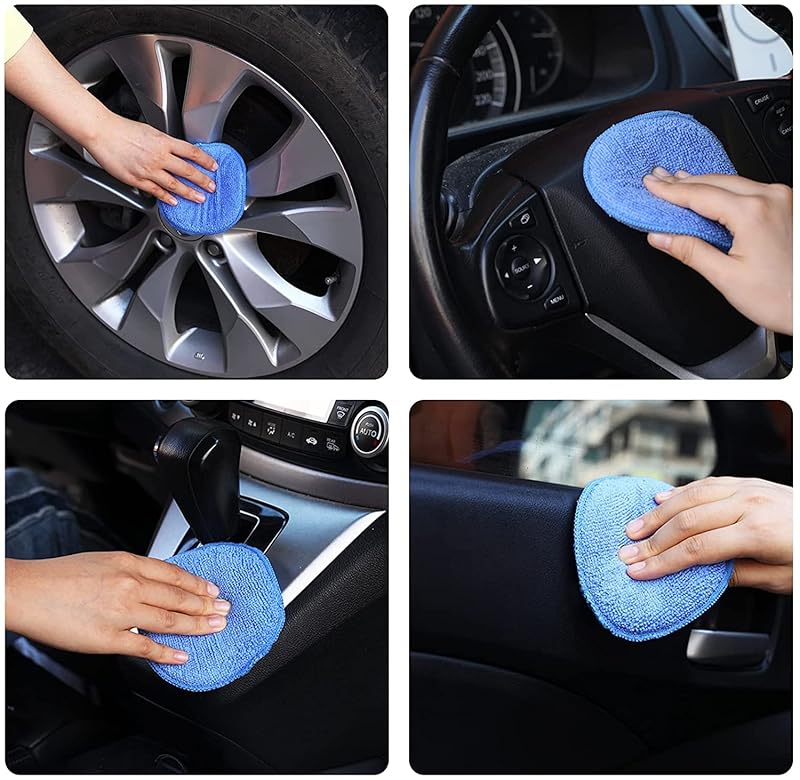
FONAROLL Microfiber Wax Applicator Pads (6 Pack, 5-inch)
These 5-inch applicator pads combine microfiber surface material with a built-in sponge core. They carry 2,888 reviews at 4.6 stars and cost $6.99 for a 6-pack.
Standout features: - Microfiber surface with foam sponge core combines absorbency of microfiber with cushioning of foam - Machine-stitched edges reduce fraying and prevent edge-to-paint scratching - Machine washable and reusable
Applicator pads are the link between your wax product and the paint surface. A bad pad applies product unevenly, absorbs too much product into the foam (wasting it), or has rough edges that mar clear coat. These FONAROLL pads address all three issues.
The microfiber-wrapped foam core provides controlled product release. The foam core compresses evenly, which means even pressure distribution and consistent product thickness across the panel. The stitched edges are a practical anti-scratch measure that cheaper pads skip.
Machine washability makes these economical long-term. For $6.99, six pads that last dozens of washes each is outstanding per-pad value.
The 2,888 reviews at 4.6 stars is a solid review base for an applicator pad category where reviews tend to be lower-volume than wash products.
The one real limitation is that these pads are designed for hand application. They're not backing plate compatible for machine polishing work, which requires different pad formats.
Pros: - Microfiber + foam core for even product distribution - Machine-stitched edges won't mar paint - Machine washable, reusable many times - 6-pack for $6.99 is excellent value
Cons: - Hand application only, not machine compatible - 5-inch size is good for body panels but slightly small for hood work - Foam core absorbs some product, can take time to fully saturate first use
Fanttik P10 Pro Mini Car Buffer Polisher (Cordless, 4000mAh)
The Fanttik P10 Pro is a cordless mini rotary polisher weighing 0.58 lbs, designed for tight spots and small surface areas. It has 35 reviews at 4.7 stars and costs $69.99.
Standout features: - 0.58 lb weight enables use on sideview mirrors, door handles, badges, and tight body contours - 4000mAh battery provides up to 50 minutes of runtime with Type-C fast charging - Planetary gear system keeps noise at 65 dB even at maximum speed
The niche for this tool is precise. Full-size 5-6 inch orbitals are excellent for large flat panels (hoods, roofs, doors) but become unwieldy on curved surfaces, tight concave areas, and small components. A mirror or A-pillar trim is nearly impossible to polish safely with a 6-inch machine. The P10 Pro fills this gap.
At 0.58 lbs and with 2-inch and 3-inch pad compatibility, it handles the spots that full-size machines simply can't reach without creating heat buildup or uneven contact. The 3-speed range (300-950 RPM) is appropriate for the lower speed requirements of small-area work.
The cordless design is genuinely useful here. Small-area work involves moving around the car frequently, and a cord limits mobility exactly where you want maximum maneuverability.
The 35-review count is the main caveat. It's a new product with limited real-world feedback. The early reviews are positive, but I'd want more data before giving it my full confidence. At $69.99, it's an investment without the review backing to fully justify it yet.
Pros: - Genuinely fills a gap that full-size polishers can't reach - Cordless with 50-minute runtime - Quick-change pad system swaps between 2" and 3" pads - Low noise at 65 dB makes sustained use comfortable
Cons: - Only 35 reviews, insufficient track record for confident recommendation - Limited power for deep correction work, suited only for finishing and maintenance - $69.99 is significant for a specialty tool with limited primary use cases
Seesii 1600W Variable Speed Rotary Polisher (7"/6")
The Seesii is a 1600W rotary polisher with 7 speeds from 2,056 to 3,600 RPM, dual detachable handles, and a speed lock function. It has 18 reviews at 4.7 stars and costs $49.99.
Standout features: - 1600W pure copper motor handles aggressive correction work including heavy oxidation and deep scratches - 7 variable speeds with a lock button for consistent RPM on large panels - Ergonomic dual-handle design with both D-handle and side handle for control
At $49.99, the Seesii is the most aggressively priced high-wattage rotary in this guide. The 1600W motor is genuine cutting power, appropriate for removing heavy oxidation, deep swirl marks, and surface defects that dual-action orbitals struggle with.
Here's the critical context: rotary polishers are not for beginners. The high RPM and constant rotational motion (not the random oscillation of a dual-action) concentrate heat in a small area quickly. On thin clear coat or with too much pressure, a rotary can cut through the clear coat in seconds. This is not a theoretical risk. It's a documented outcome when rotary polishers are misused.
For experienced detailers who understand cutting compounds, pad selection, and proper speed management, the Seesii's power-to-price ratio is attractive. At $49.99 for 1600W with 7 speeds, you get more power per dollar than most competitors.
The 18-review count is a genuine concern. A rotary polisher is a tool where quality control matters a lot, and 18 reviews doesn't validate that.
For DIY enthusiasts and professional detailers, this is worth watching as the review count grows. For beginners: start with a dual-action orbital instead.
Pros: - 1600W copper motor provides serious cutting capability - 7 speeds cover from delicate finishing to aggressive correction - Speed lock for consistent results on large flat surfaces - $49.99 is extremely competitive for the wattage
Cons: - Only 18 reviews, quality and reliability unproven at scale - Rotary polishers require skill and technique to use safely - Not appropriate for beginners who lack paint correction experience - Requires cool-down every 30 minutes at high speed
Dobetter 1500W Constant Speed Car Buffer with LCD Display
The Dobetter constant-speed buffer features a 1500W motor, real-time LCD RPM display, and 6-speed adjustment from 1000-3500 RPM. It has 17 reviews at 4.7 stars and costs $43.99.
Standout features: - Real-time LCD display shows exact RPM with ±1% accuracy, eliminating speed guesswork - Constant speed technology maintains set RPM even under load, preventing motor bogging - 4-meter (13-foot) cord provides full 360° reach around most vehicles
The LCD display is a genuinely useful differentiator. Most buffers use mechanical dial speed adjustment, which is approximate. Knowing your exact RPM in real time is meaningful for paint correction work where speed selection directly affects whether you're finishing or cutting.
The constant speed feature is similarly practical. When a polisher bogs down under pressure, it increases friction in unpredictable ways. Constant-speed electronics maintain the set RPM regardless of load, giving more consistent results.
At 1500W and a 1000-3500 RPM range, this is lower RPM than the Seesii's 2056-3600 range, which makes it slightly more approachable for less experienced users while still providing adequate cutting power.
Again, 17 reviews is not enough to confidently assess reliability. Both the Seesii and Dobetter are priced well below established brands for comparable power, which is compelling for budget-focused buyers but comes with more uncertainty.
Pros: - LCD display provides real-time accurate RPM feedback - Constant speed electronics prevent bogging under pressure - 4-meter cord is generous reach - $43.99 is competitive for the feature set
Cons: - Only 17 reviews, insufficient for confident quality assessment - Low-range RPM (1000+) means this is a polisher/waxer rather than an aggressive correction machine - LCD adds complexity compared to simpler mechanical controls
SPTA 5-Inch Dual Action Orbital Polisher (DAPSET-US)
The SPTA DAPSET-US is a 750W dual-action orbital polisher with 6 speed settings and a full accessory kit including 8 polishing pads in two sizes. It has 1,682 reviews at 4.6 stars and costs $99.44.
Standout features: - Dual-action random orbital motion is significantly safer for beginners than rotary polishers - 6 variable speeds from 2,000-5,200 RPM cover waxing to paint defect removal - Complete kit includes 4 each of 5-inch and 6-inch polishing pads plus a carrying bag
The SPTA DAPSET-US is my recommendation for first-time machine polishing. The dual-action (random orbital) motion means the pad rotates and oscillates simultaneously in a random pattern. This random motion prevents the heat buildup that makes rotary polishers dangerous and significantly reduces the risk of burning clear coat. You can stall a dual-action on the paint and it won't burn through it.
At 750W with 6 speeds, the SPTA handles waxing, light polishing, and moderate swirl removal effectively. It won't do what a 1600W rotary does with heavy oxidation, but for the vast majority of home detailing tasks, the power level is appropriate.
The 1,682 reviews at 4.6 stars is the strongest review base among the machine polishers in this guide. That's meaningful. The most common criticism in the reviews is noise at high speeds (standard for 750W machines) and the basic quality of the included pads. Buy higher-quality pads separately if you're doing correction work.
The complete kit format is a practical advantage. A buffer with no pads is useless. Having 8 pads from day one means you can actually start using it immediately.
Pros: - Dual-action orbital is the correct tool for beginning machine polishers - 1,682 reviews at 4.6 stars, the most proven machine buffer in this guide - 8 included pads allow immediate use - 6 speeds cover waxing through light correction
Cons: - Included pads are basic quality, serious correction work benefits from better pads - 750W limits effectiveness on heavy paint correction tasks - At $99.44, the most expensive single product in this guide
VERVEWAVE Cordless Buffer for DeWalt 20V Battery (Tool Only)
The VERVEWAVE cordless buffer uses a brushless motor and fits DeWalt 20V batteries (not included). It has 327 reviews at 4.6 stars and costs $89.99.
Standout features: - Brushless motor provides more power efficiency, lower noise, and longer service life than brushed motors - Fits the entire DeWalt 20V MAX battery lineup (DCB200-DCB240 series) - 6 variable speeds from 1,800-5,500 RPM
If you own DeWalt 20V tools, the battery ecosystem argument is compelling. DeWalt batteries are expensive when purchased standalone but cost nothing incremental if you already own them. The VERVEWAVE turns your existing DeWalt battery investment into a cordless polisher without buying additional battery infrastructure.
The brushless motor is a meaningful upgrade over brushed motors in the same price range. Brushless motors run cooler, last longer, and provide more consistent power output under load. For a polisher, that means more stable speed and less heat buildup during extended sessions.
The "tool only" designation is critical to understand before purchasing. The $89.99 price assumes you have compatible DeWalt 20V batteries. If you need to buy a battery too, add $40-80 to the effective cost.
At 327 reviews and 4.6 stars, this has enough feedback to have real confidence in the core functionality. The negative reviews mostly involve cord management (not relevant here, it's cordless) and the occasional battery compatibility confusion.
Pros: - Cordless design provides complete freedom of movement - Brushless motor is more efficient and durable than brushed alternatives - DeWalt battery compatibility is a significant advantage for existing DeWalt owners - 327 reviews at 4.6 stars provides adequate confidence
Cons: - "Tool only" requires existing DeWalt 20V batteries, adds cost for new users - 6-inch orbital is limited for very small detail areas - Brushless motor benefits are less meaningful at this power level for casual users
Niusken Cordless Car Buffer Polisher with Dual Batteries (21V)
The Niusken cordless polisher includes two 21V 2000mAh batteries, an LED display, and 18 accessories for $59.99. It has 220 reviews at 4.6 stars.
Standout features: - Two batteries included allow uninterrupted work by rotating between them while one charges - LED display shows current speed and battery level in real time - 6 speeds from 2,800-5,800 RPM with overheating protection
The dual-battery inclusion is the most practical feature here. A single battery on a cordless polisher means stopping mid-detail when it runs low. Two batteries mean you charge one while using the other, which essentially eliminates dead-battery interruptions for normal-length detail sessions.
The LED display adds useful visibility of both speed (in RPM) and battery level without guessing. For someone new to machine polishing, knowing where they are in both variables reduces uncertainty.
At $59.99 with two batteries, the per-dollar value versus the VERVEWAVE ($89.99, no batteries) is significant if you don't already have DeWalt batteries. Two 21V 2000mAh batteries plus the polisher for $59.99 versus a tool-only DeWalt-compatible polisher for $89.99 plus battery cost of $40-80.
The 220-review count is modest but adequate. The overheating protection that shuts down the unit after 20 minutes of continuous high-speed use is a real limitation for long polishing sessions but an appropriate safety feature given the motor size.
Pros: - Two batteries included, the best dual-battery value in this guide - LED display for real-time speed and battery monitoring - $59.99 all-in with batteries is excellent value compared to tool-only alternatives - 18 accessories included for immediate use
Cons: - Overheating protection shuts down after 20 minutes at high speed, limits long sessions - 2000mAh batteries provide limited runtime per charge on high settings - 220 reviews is adequate but not extensive
AIDERAR Brushless Cordless Buffer for DeWalt 20V (Tool Only)
The AIDERAR brushless cordless polisher features a 1000W motor, 15mm orbit size, and is designed specifically for DeWalt 20V MAX batteries. It has 64 reviews at 4.6 stars and costs $67.49.
Standout features: - 15mm orbit is larger than the typical 8-12mm DA polisher orbit, improving surface coverage efficiency by 45%+ - 1000W brushless motor provides more power than most competing DA polishers - 5-speed control from 2,000-4,600 OPM for versatile use
The 15mm orbit size is a real technical differentiator. Most dual-action polishers use 8-12mm orbits. A larger orbit means the pad covers more unique ground per rotation, which translates to faster material removal and fewer passes needed to cover a panel. AIDERAR claims 45% efficiency improvement, which aligns with the physics of larger orbit diameter.
For the experienced hobbyist who finds standard DA polishers slow for full-car work, the 15mm orbit meaningfully speeds up the process without introducing the safety risks of a rotary.
The 1000W brushless motor combined with the 15mm orbit makes this one of the more capable DA polishers in this price range. The DeWalt 20V battery compatibility is the same double-edged consideration as the VERVEWAVE: great if you own the batteries, less compelling if you don't.
At 64 reviews and 4.6 stars, the review base is thin. This is a product worth tracking as more reviews accumulate, but currently requires more trust in specifications than in documented user experience.
Pros: - 15mm orbit significantly improves coverage efficiency over standard DA polishers - 1000W brushless motor provides serious power for DA application - DeWalt 20V compatible for existing DeWalt users - Competes on specs against products costing $50-100 more
Cons: - Only 64 reviews, minimal real-world validation - "Tool only," requires DeWalt 20V batteries - Larger orbit means less precision on small or curved surfaces
SundpeyPRO Brushless Cordless Buffer Polisher (8000 RPM, 8-Speed)
The SundpeyPRO features a brushless motor reaching 8000 RPM, 8 speed settings, two batteries, and a 10-piece polishing kit for $49.99. It has 26 reviews at 4.6 stars.
Standout features: - 8000 RPM maximum speed is the highest in this guide for a cordless polisher - 8 speed settings provide finer speed control than most 6-speed alternatives - 9mm random orbital with 6-inch pad size, dual batteries included
The 8000 RPM maximum speed is unusually high for a cordless DA polisher. Combined with the 8-speed granularity, this is a machine that offers more precision at the high end of the speed range than competitors.
Whether 8000 RPM is useful depends on your use case. For waxing and light polishing, 3,000-4,000 RPM is plenty. The higher ceiling matters for paint correction work where you need more pad speed to cut effectively without switching to a rotary. Having more speed available is always better than being limited.
At $49.99 with two batteries and 10 polishing accessories, the value is exceptional if the quality holds. The 26-review count is the significant caveat. At this price with this spec sheet, I'd want 200+ reviews to be confident in durability claims.
For buyers who want maximum feature count per dollar and are willing to accept the risk of a newer product, this is a compelling option. For those who prioritize confidence, the SPTA at $99.44 with 1,682 reviews is the safer choice.
Pros: - 8000 RPM maximum speed is the highest cordless polisher in this guide - 8-speed settings provide finer precision control - Two batteries and 10 accessories included at $49.99 - Lightweight at 2.76 lbs
Cons: - Only 26 reviews, minimal track record for quality assessment - 9mm orbit is smaller than AIDERAR's 15mm, less coverage per pass - High RPM without sufficient technique can cause paint damage
Buying Guide: What to Look For in Car Wax Buffers
Dual-Action vs. Rotary: The Most Important Decision
Dual-action (DA) orbital polishers use a random oscillating motion that prevents heat buildup. They're slower at material removal but far safer for beginners and intermediate users. Rotary polishers spin in a single direction, cut faster, and generate more heat. For serious paint correction work, rotaries are more powerful. For maintenance, waxing, and beginner correction, DA polishers are the right choice.
If you're new to machine polishing, start with a DA. Rotaries need technique and experience. Use the wrong speed with the wrong pad on thin clear coat with a rotary and you'll see bare metal.
Corded vs. Cordless
Corded polishers provide consistent power throughout use and generally cost less for equivalent wattage. Cordless polishers offer freedom of movement that's genuinely useful when working around a full vehicle. For home detailers, cordless is convenient but battery life is a real consideration. For professional or high-volume detailing, corded provides unlimited runtime. The DeWalt battery compatibility options are compelling if you already own the platform.
Orbit Size for DA Polishers
Larger orbit diameters (12-15mm) cover more surface per rotation than smaller ones (8-10mm). More coverage per pass means faster work and fewer total passes. For large flat panels, larger orbits are efficient. For smaller, curved areas, smaller orbits give more control. Mid-range (10-12mm) is the versatile choice.
Speed Range
The speed range determines what tasks a polisher can handle. A polisher that starts at 2,000+ RPM minimum can't slow down enough for delicate finishing work. Polishers with a lower minimum (1,000-1,500 RPM) are more versatile for fine finishing and wax application. The SPTA at 2,000-5,200 RPM is a good range for general use. The Dobetter at 1,000-3,500 RPM adds low-speed capability for gentler work.
Pad Quality Matters More Than The Machine
Experienced detailers will tell you that pad selection has more impact on results than polisher brand. A cutting pad removes material aggressively. A finishing pad polishes to a high gloss. Foam pads, microfiber pads, and wool pads each behave differently. Whatever machine you buy, invest in quality pads from Lake Country, Meguiar's, or Chemical Guys for the specific tasks you're doing. The included pads in budget kits are starting points, not the final word.
Frequently Asked Questions
Can a beginner use a rotary polisher safely? With proper education, yes, but I don't recommend starting there. DA polishers are forgiving of beginner mistakes. Rotaries are not. Learn on a DA, understand how speed, pressure, and pad hardness interact with paint, and then graduate to a rotary with a clear understanding of the risks. Most enthusiasts never need a rotary for home detailing.
What does "single-stage paint" mean and why does it matter for polishing? Single-stage paint is color and protection in one layer, without a separate clear coat. Most pre-1990s cars have single-stage paint. Modern vehicles have base coat plus clear coat. Single-stage paint is more forgiving of polishing (cutting into it removes color but it's still protected paint). Clear coat is more delicate because you're working in a thin protective layer with bare color coat underneath. Know which your car has before using aggressive compounds.
How often should I buff and wax my car? Machine polishing for correction should be done sparingly, once or twice per year at most, because polishing removes a small amount of clear coat each time. There's only so much clear coat to work with. Waxing (no correction) can be done every 2-3 months without any clear coat concern.
What's the difference between a polisher and a buffer? In common usage, the terms are used interchangeably. Technically, a polisher uses polish compounds to correct paint (removing material), while a buffer applies and buffs wax or sealant without correction. In practice, DA and rotary machines can do both depending on the pad and product combination.
Do I need a car wax buffer for a car detailing buffer job, or can I do it by hand? For wax application and removal, hand application with quality pads works well for most cars. For paint correction (removing swirl marks, scratches, and oxidation), hand application doesn't generate enough consistent pressure and speed. If you want actual correction results rather than just wax protection, a machine buffer is the right tool.
Is the Meguiar's Cleaner Wax safe for daily drivers? Yes. The mild abrasives in Meguiar's Cleaner Wax are designed for safe use on all glossy finishes including modern clear coat. It's gentler than dedicated cutting compounds. Applied by hand with appropriate pressure, it removes minor surface marks and improves gloss without damaging clear coat.
Conclusion
For most home detailers starting with machine polishing, the SPTA DAPSET-US at $99.44 is the right first machine. The 1,682-review track record and dual-action safety make it the lowest-risk entry point into machine polishing. The 8-pad kit means you can start immediately.
For hand waxing without any machine investment, Meguiar's Cleaner Wax at $9.99 plus FONAROLL applicator pads at $6.99 is a complete, proven setup for under $20.
For cordless flexibility, the Niusken dual-battery kit at $59.99 all-in with two batteries beats the DeWalt-compatible alternatives on total cost for buyers who don't already own DeWalt batteries.
More detailed guidance on correction technique is available in our car detailing buffer and detailing buffer guides.