




Affiliate disclosure: This article contains affiliate links. If you purchase through these links, I may earn a commission at no extra cost to you.
Best Paint Decontamination Products: Removing What Washing Can't
Every car wash removes loose surface dirt. It does nothing about bonded contamination, the microscopic metallic particles, industrial fallout, rail dust, and tree sap residue that embed themselves into your paint and feel like sandpaper even after washing.
Paint decontamination addresses this. It's the step between washing and polishing that most home detailers skip, and it's the reason professionally detailed cars feel smoother and look more reflective than a freshly washed car that never gets decontaminated.
This guide covers the best products for chemical and mechanical decontamination, from iron removers to clay towels. For context on how decontamination fits into the full process, see our guides on paint decontamination, decontamination car wash, and car detailing.
Quick Picks
| Product | Best For | Price |
|---|---|---|
| P&S Reset Clay Decontamination Towel | Professional-grade clay towel, 432 reviews | $37.95 |
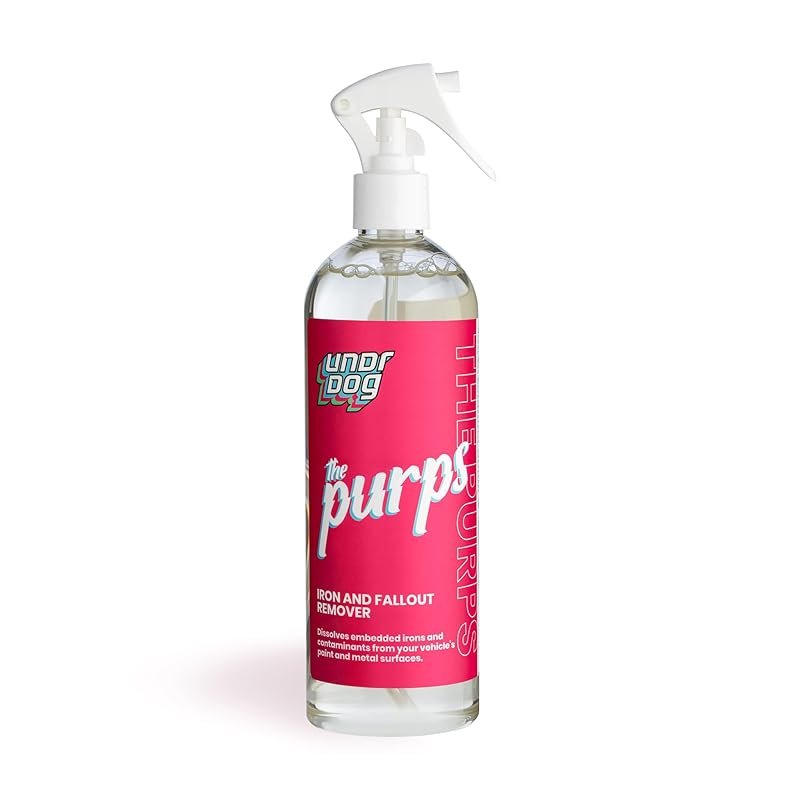
| Undrdog The Purps Iron Remover (32 oz) | Visual iron removal with color change | $16.99 |
| MANIAC LINE MAFRA Iron Remover (1 Liter) | Professional iron fallout removal | $19.99 |
| Chemical Guys Clay Luber (16 oz) | Lubrication for clay bar work | $10.99 |
| Liznkjious 3-Pack Clay Towels + Storage Bag | Best value clay towel set | $17.99 |
Product Reviews
P&S Reset Clay Decontamination Towel (12" x 12")
P&S Professional Detail Products is one of the most respected names in professional detailing chemistry. Their Reset Clay Towel uses rubber polymer technology that removes bonded contamination up to three times faster than traditional clay bars, according to P&S's own testing.
Standout features: - Rubber polymer technology removes contamination faster than traditional clay bars - Removes industrial fallout, overspray, rail dust, water spots, and surface rust - Prepares surfaces for maximum wax, sealant, and coating adhesion
At $37.95 with 432 reviews at 4.8 stars, this is the best-validated clay towel on this list. The review depth and the P&S brand reputation make this the safest choice for a first clay towel purchase. Professional detailers use P&S products because the formulations are consistent and tested.
The honest limitation is price. At nearly $38, it's significantly more expensive than the newer brands on this list. The rubber polymer technology does perform differently from traditional clay, covering more area per pass with less drag. On a contaminated black vehicle, the improvement in paint smoothness after using this versus a traditional clay bar is noticeable.
The towel is 12" x 12", which means one pass covers roughly 4x the area of a standard clay bar. Work with a quality lubricant, keep the surface wet, and move in straight lines rather than circles.
Pros: - P&S brand reputation and 432 reviews provide strong validation - Rubber polymer removes contamination faster than traditional clay - Large 12" x 12" surface area covers more per pass
Cons: - $37.95 is the highest price on this list for a clay towel - Rubber polymer technology feels different from traditional clay, requires adjustment - One towel means washing during a full detail session is necessary
Undrdog The Purps: Iron & Rust Remover (32 oz)
The Purps is an iron remover with a visual indicator. It sprays on clear and turns purple (hence the name) as it reacts with iron particles and ferrous fallout embedded in the paint surface. Watching it work tells you exactly where your contamination is.
Standout features: - Clear-to-purple color change visualizes the iron removal process in action - Formulated for both wheels and painted surfaces, dual-surface safe - 32 oz bottle provides substantial coverage at the use rate
At $16.99 with 2 reviews at 5 stars, the review data is extremely limited. But the color-change mechanism is real chemistry, not a gimmick. Iron removers work by converting ferrous iron compounds into water-soluble forms that rinse away. The color change is the reaction product of iron thiocyanate formation, a real indicator of iron contamination being dissolved.
I'd use this product for wheel decontamination where iron fallout from brake dust is heaviest, and for panel treatment on vehicles with visible rust speckling or orange spots. The 32 oz volume at $16.99 is good value if the formula performs at the quality level suggested by the description.
Pros: - Color-change confirmation lets you see contamination level before rinsing - Dual-use for wheels and paint surfaces - Generous 32 oz volume at $16.99
Cons: - Only 2 reviews, performance essentially unverified - Color-change feature can't compensate for unknown formula quality - Newer brand without established community reputation
MANIAC LINE MAFRA Iron Remover (1 Liter)
Mafra is an Italian automotive care brand with strong distribution in Europe and growing recognition in the US market. The MANIAC LINE Iron Remover uses a visible reaction to show where it's working on metal particles from brakes and rail dust.
Standout features: - Visible reaction highlights treated zones for complete coverage confirmation - Fine wetting reaches panel edges, creases, and spoke pockets on wheels - Treats bodywork panels, door lowers, side glass, and high-load areas
At $19.99 for 1 liter with 8 reviews at 4.8 stars, Mafra offers more review validation than competing iron removers at similar prices. The European brand's quality standards are generally high. The 1-liter volume is generous for the price.
The product is particularly useful after highway driving where rail dust accumulation is highest, and after winter driving where road salt promotes rust formation on brake components. Apply, let it react for 3-5 minutes (watch for color change), agitate with a soft brush on wheels, rinse thoroughly.
Pros: - More review validation than competing iron removers at this price - Mafra brand provides more credibility than unknown alternatives - 1 liter is generous volume for the price
Cons: - Still only 8 reviews, limited US market track record - Italian brand may lack local customer support - Must be rinsed thoroughly to prevent residue on painted surfaces
PRAZISCHUTZ Surface Prep Spray (150ml)
This product is a surface degreaser and prep spray rather than a clay bar lubricant or iron remover. It removes oil, wax, silicone, and road grime to create a clean base for ceramic coating, vinyl wrap, or paint adhesion.
Standout features: - Removes wax, silicone, and oil residue that interfere with coating adhesion - Non-corrosive formula safe for clear coat, paint, metal, and plastic - Spray-and-wipe application, no rinsing required
At $14.99 for 150ml with 2 reviews at 5 stars, this is a specialized product for a specific task: surface preparation before applying a ceramic coating, PPF, or vinyl wrap. It's not a clay bar lubricant or a general decontamination product.
The 150ml size is small. For a full vehicle degreasing pass before ceramic coating installation, you'd likely need multiple bottles. For targeted spot decontamination or small prep areas, one bottle works fine.
Pros: - Purpose-built for coating prep, removes silicone and wax residue - Non-corrosive, safe on all painted and plastic surfaces - Spray-and-wipe, no rinsing needed
Cons: - 150ml is very small for full vehicle prep - Only 2 reviews, performance unverified - Not a clay lubricant or decontamination product, narrow use case
BAYUJANE Upgrade 3.0 Car Decontamination Towel (12" x 12")
The BAYUJANE towel features an upgraded reticulated mesh structure on the clay side that traps lifted contaminants within the mesh rather than holding them against the paint surface. This is a meaningful engineering improvement over flat clay surfaces.
Standout features: - Reticulated mesh structure traps contaminants rather than holding them against paint - Dual-sided design: microfiber for light dusting, clay side for decontamination - Premium clay polymer and high-density microfiber construction
At $18.59 with 6 reviews at 5 stars, the mesh design is the differentiator. Traditional clay towels have flat clay surfaces. As contamination builds up, you have to fold the towel to a clean section. The mesh design theoretically extends working time between folds by trapping particles inside the mesh.
With only 6 reviews, I can't confirm how well this works long-term. The concept is sound. The material description is detailed and specific. I'd use this on a vehicle where contamination is moderate, not for heavily contaminated paint where more proven products are safer.
Pros: - Mesh structure is a genuine engineering improvement over flat clay surfaces - Dual-sided design adds microfiber utility - Reasonable price at $18.59
Cons: - Only 6 reviews, too limited to evaluate long-term performance - Unknown brand without community validation - Mesh design claims are unverified by independent testing
Liznkjious 3-Pack 12" Clay Towels + Storage Bag
The Liznkjious set offers three clay towels plus a storage bag at $17.99. The claim of covering an SUV in 40 minutes versus 2+ hours with traditional clay bars is consistent with what other clay towel users report. The included storage bag prevents cross-contamination between sessions.
Standout features: - 3-pack with storage bag provides comprehensive coverage and protection between uses - Claims 30+ uses per towel for extended lifespan vs. Traditional clay bars - Dual-side design: microfiber pre-clean side plus clay decontamination side
At $17.99 for three towels plus storage with 2 reviews at 5 stars, the kit approach at this price is good value if the quality holds up. Having three towels means you can use separate towels for different vehicle areas (painted surfaces vs. Glass vs. Wheels) and keep them from cross-contaminating each other.
The 2-review limitation is the main concern. The product claims are specific and the design is thoughtful, but I'd want to see 50+ reviews before recommending this for use on a freshly corrected or ceramic-coated vehicle.
Pros: - Three towels plus storage bag is best set value on the list - Dedicated storage prevents contamination between sessions - Claimed 30+ uses per towel extends value significantly
Cons: - Only 2 reviews, performance completely unverified - Three towels means carrying more bulk in mobile kit - Claims of 30+ uses per towel cannot be validated
Chemical Guys Clay Luber Synthetic Lubricant (16 oz)
Clay Luber is not a decontamination product itself, but it's essential to any clay bar or clay towel process. Without adequate lubrication, clay can drag, stick, or mar paint surfaces. Chemical Guys Clay Luber uses synthetic wetting agents and lubricants specifically formulated to work with clay bars, clay mitts, and clay blocks.
Standout features: - Synthetic wetting agents extend the working life of clay bars by reducing friction - Non-caustic formula safe for all paint types and surfaces - Works with every type of clay: traditional bars, synthetic blocks, clay mitts
At $10.99 for 16 oz with 3,497 reviews at 4.7 stars, this is the most-reviewed and most-validated clay lubricant on this list by a significant margin. The consistent performance across thousands of users makes it the default recommendation for anyone doing clay work.
Clay Luber also works as a final detail spray between washes and as a clay lubricant when used at 1:1 dilution with Meguiar's Professional Detailing Clay. Keep a 16 oz bottle in your kit any time you're doing paint decontamination work.
Pros: - 3,497 reviews at 4.7 stars, the most validated product on this list - Multi-use: clay lubricant and quick detailer between washes - Extends clay bar and towel life by reducing friction
Cons: - Not a decontamination product itself, purely a lubricant - 16 oz is consumed quickly during full vehicle clay work - Some users find the formula thinner than preferred for very contaminated surfaces
Buying Guide: What to Look for in Paint Decontamination Products
Chemical vs. Mechanical decontamination. Iron removers work chemically, dissolving metallic fallout without physical contact. Clay bars and clay towels work mechanically, physically lifting bonded contamination from the surface. A complete decontamination protocol uses both in sequence: iron remover first, then clay after washing.
Clay bar vs. Clay towel. Clay bars provide more tactile feedback and precise control. Clay towels cover more surface area per pass and work faster on large panels. Both methods require lubrication. Clay towels are generally safer for beginners because the larger contact surface distributes pressure more evenly.
Iron remover chemistry. Look for products that specifically describe a "color-change reaction" for visual confirmation. This indicates iron thiocyanate chemistry, which is the active reaction mechanism. Products without this aren't necessarily inferior, but the visual indicator is useful for confirming contact time and coverage.
Lubrication is not optional. Using a clay bar or towel without sufficient lubrication is one of the fastest ways to induce micro-scratches in your paint. If you can hear or feel the clay dragging, add more lubricant immediately. Clay Luber or a diluted quick detailer applied liberally is the standard.
When to decontaminate. Perform a "plastic bag test" by wrapping your hand in a plastic bag and running it over your washed, dry paint surface. If you feel texture or resistance (like touching Velcro), your paint needs decontamination. Smooth means you're good. Most vehicles need decontamination every 6-12 months depending on driving conditions.
FAQ
What does paint contamination actually look like? You usually can't see it. Bonded metallic particles are microscopic. What you feel is more relevant: run your fingertip over washed, dried paint. If it feels rough or grainy rather than smooth as glass, that's contamination. Iron particles can also appear as tiny orange or brown specs on white paint.
Is decontamination necessary before waxing? Waxing over contaminated paint seals in the contamination and produces a bumpy, less-glossy result. Decontamination before waxing is standard practice. See the detailing your car guide for the proper sequence.
Can I use clay on windshields? Yes. Glass is an excellent candidate for clay decontamination. The improvement in glass clarity and wiper performance after claying a windshield is substantial. Use the same clay lubricant and technique as on paint.
How do I know if my clay towel or bar is spent? When the clay surface becomes uniformly dark with trapped contamination and refolding or rinsing doesn't restore cleaning ability, it's time to replace it. Also discard any clay that gets dropped on the floor. Ground contamination embedded in clay will scratch paint.
What's the difference between decontamination and paint correction? Decontamination removes bonded surface contamination. Paint correction addresses scratches, swirls, and oxidation in the paint itself. Decontamination typically comes before paint correction. Check the full detailing process for where both steps fit.
Can iron remover damage my paint? Iron remover is safe on paint, glass, and metal when used as directed. Avoid leaving it on surfaces for extended periods beyond the recommended dwell time (typically 3-5 minutes). Don't use it in direct sunlight or on hot surfaces, as rapid evaporation can concentrate the formula and cause issues.
Conclusion
For a reliable, professional-grade clay decontamination product, P&S Reset Clay Towel at $37.95 is the recommendation. The rubber polymer technology and strong review validation justify the higher price for anyone serious about paint preparation.
Always pair clay work with Chemical Guys Clay Luber at $10.99. It's the most-tested lubricant available and costs less per use than most alternatives.
For vehicles with heavy brake dust or industrial fallout contamination, add the Undrdog The Purps or MANIAC LINE MAFRA iron remover as a chemical decontamination step before your clay work. The combination of chemical and mechanical decontamination produces the smoothest paint possible before polishing or protection application.