




Best Mobile Detailing Pressure Washer: Top Picks for Detailers on the Go
Affiliate disclosure: This article contains affiliate links. If you purchase through our links, we may earn a commission at no extra cost to you.
Running a mobile detailing business means your pressure washer needs to do things a garage unit doesn't. It needs to be compact enough to fit in a trailer or truck bed, light enough to carry on a job site, and reliable enough to run through 5-10 cars on a single day's work without drama.
I've looked at the best options across different price points and configurations. Whether you're a professional mobile detailer setting up your first rig or a serious enthusiast who wants a capable unit that travels well, this guide has what you need.
My criteria were focused on portability, PSI that's safe for car paint (1200-2500 PSI is the car-safe range for most nozzles), water source flexibility, and real-world review data. I avoided anything with less than 50 reviews since car detailing pressure washers need proven reliability.
Quick Picks
| Product | Best For | Price | Rating |
|---|---|---|---|
| Westinghouse ePX3500 | Best all-around mobile detailing washer | $169.00 | 4.6★ |
| Westinghouse ePX3100 | Mid-range reliable workhorse | $139.00 | 4.6★ |
| Westinghouse ePX3050 | Budget-friendly entry with foam cannon | $89.99 | 4.6★ |
| MZK Pressure Washer | High-rated compact with foam cannon | $99.98 | 5★ |
| Westinghouse ePX3100v | Best handheld/portable format | $129.00 | 4.7★ |
Product Reviews
MZK Pressure Washer
A compact, versatile washer with a foam cannon that earns its 5-star rating.
The MZK pressure washer comes in at $99.98 with 99 reviews at 5 stars. That's a remarkable rating for a power tool with a meaningful review count. The anti-tipping technology is a smart design decision for mobile use: pressure washers on job sites deal with uneven surfaces and equipment that gets kicked or bumped.
The four quick-connect metal nozzles (0°, 15°, 25°, 40°) cover the range from stubborn driveway staining to gentle car paint rinsing. The included foam cannon takes it from a basic rinse tool to a proper car washing setup. For mobile detailing, the 21-foot hose and 17-foot power cord provide enough reach to work around most vehicles without repositioning the unit constantly.
The four swivel wheels and the ability to pull water from a bucket rather than requiring a pressurized faucet connection are genuinely useful for mobile work. Many job sites don't have conveniently located outdoor faucets, and bucket-fed operation gives you flexibility.
The honest limitation is that 99 reviews at 5 stars, while impressive, is a relatively small sample for an electric power tool where long-term reliability matters. The unit's PSI specs aren't explicitly listed in the features, which makes comparing it to the Westinghouse units less straightforward. For established mobile detailing professionals, the Westinghouse units with 18,000+ reviews may be a safer long-term investment.
Pros: - 5 stars from 99 reviews, highest rating on this list - Anti-tipping technology designed for uneven job site surfaces - Can draw water from bucket for mobile flexibility - Foam cannon included, ready for car washing
Cons: - 99 reviews is limited for a long-term professional tool investment - PSI specs not clearly stated, harder to compare - New brand with shorter track record than Westinghouse
Westinghouse ePX3100v Electric Pressure Washer (Handheld)
The most portable Westinghouse model, built for detailers who need to travel light.
The ePX3100v is the handheld configuration of Westinghouse's ePX3100 platform. At $129.00 with 4,648 reviews at 4.7 stars, it's the best-reviewed single unit from Westinghouse in the detailing-friendly pressure range. The 18-pound weight and built-in carry handle make it genuinely portable in a way that larger units aren't.
The 2100 max PSI and 1.76 max GPM specs are appropriate for car detailing with proper nozzle selection. Using the 25° or 40° nozzle for car paint rinse is standard practice, and 2100 PSI at the right distance doesn't risk paint damage. The detachable foam cannon enables proper two-bucket or foam-lance washing technique.
The auto-stop pump feature that shuts off when the trigger isn't engaged is important for motor longevity in mobile use, where the unit might sit idling between tasks during a detail job.
The 20-foot hose is slightly shorter than competitors but adequate for most vehicles. The limitation is that the handheld format means no wheels, so you carry it rather than roll it. For mobile detailers who load and unload equipment multiple times per day, the weight savings justify the format.
For mobile car washing setups where portability is the top priority, this is the right choice.
Pros: - 4,648 reviews at 4.7 stars, best-reviewed handheld on this list - 18 pounds with carry handle, genuinely portable - Foam cannon included for proper car washing setup - Auto-stop preserves pump and motor life
Cons: - No wheels, requires carrying rather than rolling - 20-foot hose is shorter than competitors' 25-foot options - Single-hand format less stable when operating from ground position
Westinghouse ePX3500 Electric Pressure Washer
The best all-around choice for mobile detailing work.
If I had to pick one pressure washer for mobile detailing, the Westinghouse ePX3500 would be it. The 18,801 reviews at 4.6 stars is the most compelling data point on this list. That's not a brand's marketing figure; it's tens of thousands of buyers saying this unit works reliably across a range of cleaning applications.
The 2500 max PSI and 2000 rated PSI put it squarely in the upper range of car-safe pressure washing with proper nozzle choice. The five-nozzle set (0°, 15°, 25°, turbo, and soap applicator) covers everything from degreasing engine bays to applying foam wash. The 25-foot hose reaches around even large SUVs and trucks without repositioning.
The anti-tipping design with four quick-lock wheels and 360° steering makes it practical for mobile work. The 20-ounce onboard soap tank eliminates the need for a separate foam cannon for soap application, though a quality foam cannon still produces better foam density. The ePX3500 weighs 19 pounds at 16.5 inches tall, compact enough for truck bed or trailer storage.
The limitation is price: at $169.00, it costs $30 more than the ePX3100 and $80 more than the ePX3050. For professional mobile detailing where the unit will run daily, that price difference is negligible over the unit's lifespan. For occasional home use, the ePX3050 at $89.99 makes more financial sense.
Pros: - 18,801 reviews at 4.6 stars, most proven unit on this list - 2500 PSI provides headroom for heavy degreasing tasks - Anti-tipping 360° steering for stable mobile use - 25-foot hose with onboard soap tank
Cons: - $169.00 is premium pricing vs. The budget alternatives - Heavier than the handheld ePX3100v at similar performance - The 2500 PSI requires careful nozzle selection for car paint safety
Westinghouse ePX3100 Electric Pressure Washer
The mid-range sweet spot at $139, with the same review base as the ePX3500.
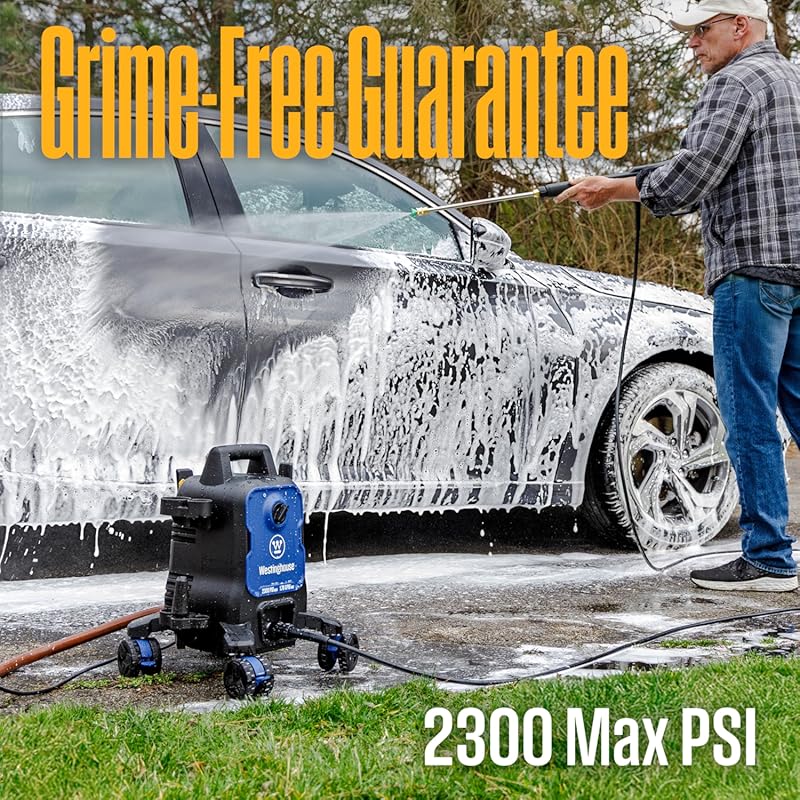
The ePX3100 shares the same 18,801 review pool as the ePX3500 because they're variants of the same platform. At $139.00 with 2300 max PSI and 1900 rated PSI, it delivers 87% of the ePX3500's peak pressure at 82% of the price.
For car detailing specifically, the difference between 2300 and 2500 max PSI is irrelevant in practice. Both require a 25° or 40° nozzle for safe paint rinsing, and at the right distance both will clean effectively. The practical specs (25-foot hose, 20oz soap tank, five-nozzle set, anti-tipping wheels) are identical.
The ePX3100 is the right choice for most mobile detailers: enough pressure for any car cleaning task, proven reliability across the review base, and $30 less than the ePX3500. The only scenario where I'd step up to the ePX3500 is if you regularly clean heavy concrete or equipment that needs the extra pressure ceiling.
For mobile detailing professionals who want to minimize equipment investment without sacrificing capability, this is where the value is.
Pros: - Equivalent functionality to ePX3500 at $30 less - 18,801 shared review base provides strong reliability data - Five nozzle set and onboard soap tank for complete car washing - Anti-tipping design for mobile job sites
Cons: - $30 savings vs. EPX3500 is modest for professional buyers - 2300 PSI ceiling may limit non-detailing applications - Same platform as ePX3050 with modest PSI bump for $50 more
Westinghouse ePX3050 Electric Pressure Washer
The budget entry point for mobile detailing, with foam cannon and turbo nozzle.
At $89.99 with 2,005 reviews at 4.6 stars, the ePX3050 is the entry point to the Westinghouse lineup. The 2100 max PSI is adequate for car washing, and the included foam cannon and turbo nozzle make this a capable detailing tool right out of the box.
The 35-foot GFCI cord is notably longer than the ePX3100v's setup and eliminates extension cord needs in most mobile situations. The 5-inch never-flat wheels and 26-inch profile are designed for low-center-of-gravity stability.
What you sacrifice for the $89.99 price is the onboard soap tank (you need an external foam cannon, which is included anyway) and some of the premium wheel and steering design of the ePX3100 and ePX3500. The build quality feels slightly less polished on the ePX3050.
For someone starting a mobile car detailing operation on a limited budget, this is the right starting point. It performs the core task reliably, and 2,005 reviews at 4.6 stars confirms it's not a risk. Upgrade to the ePX3100 or ePX3500 when the business justifies it.
Pros: - $89.99 is accessible for a startup detailing operation - Foam cannon and turbo nozzle included - 2,005 reviews at 4.6 stars - 35-foot GFCI cord for extended reach
Cons: - Lower build quality vs. Higher-end Westinghouse models - No onboard soap tank - Limited specs growth for demanding professional use
SEESII Cordless Pressure Washer
The only battery-powered option on this list, for true off-grid operation.
The SEESII cordless pressure washer at $89.99 solves a specific mobile detailing problem: locations with no power access. With dual 4000mAh batteries providing 60 minutes of runtime, you can wash two SUVs back-to-back without an outlet.
The 27-foot hose is longer than most competitors, and the brushless motor design provides more consistent pressure than brushed motors. Two operation modes (ECO for lighter tasks, full power for stubborn dirt) let you extend battery life on jobs that don't need maximum pressure.
At only 4 reviews at 5 stars, this is a very new product with insufficient data to make a confident recommendation for professional use. The battery pressure washing category has improved significantly in recent years, but cordless units still don't match the continuous power output of corded units. For mobile car wash situations where power access is guaranteed, corded units are more reliable.
The honest recommendation: if you regularly work locations with no power access, this is worth evaluating. For any other situation, a corded Westinghouse unit is a more proven, lower-risk choice.
Pros: - Cordless operation for truly remote job sites - Dual batteries for 60-minute runtime - 27-foot hose, longer than most competitors - Brushless motor for consistent pressure and durability
Cons: - Only 4 reviews, essentially no data for professional reliability - Cordless pressure always limited vs. Corded units - Battery replacement cost adds to long-term expense
Giraffe Tools Wall Mounted Pressure Washer G30
The permanent installation option for mobile detailers with a fixed base of operations.
At $305.98 with 577 reviews at 4.6 stars, the Giraffe Tools G30 is for a different use case than most products on this list. This is a wall-mounted unit with a 100-foot retractable hose, designed for permanent installation in a garage or shop.
The 2900 PSI from a 1800W motor handles demanding cleaning tasks beyond car detailing. The retractable hose system keeps the workspace tidy and protects the hose from kinking and damage. The induction motor is designed for long-term, high-use reliability.
For a mobile detailer who also has a home base or detail shop, this is an excellent investment as the shop unit. It doesn't go in a trailer. But if you're processing vehicles at your own location before going out for mobile calls, the 100-foot retractable hose covers your entire driveway or shop bay without wrestling with a hose reel.
The Giraffe Tools 2-year warranty is strong for this category. The limitation is obvious: this is not mobile. If you need portability, look at the Westinghouse units. If you have a fixed base and want the best performance for stationary use, this is worth the investment.
Pros: - 577 reviews at 4.6 stars, proven reliability - 100-foot retractable hose is excellent for shop or large driveway use - 2900 PSI provides strong cleaning capability - 2-year warranty with responsive customer service
Cons: - Not portable, fixed wall installation only - $305.98 is a significant investment - Requires permanent mounting location
Adam's Polishes Active Pressure Washer 2.0 Bundle
The premium car-specific pressure washer for enthusiasts who want an optimized system.
At $397.97 for the 5-item bundle including the pressure washer and Mega Foam Car Soap, the Adam's Active Pressure Washer 2.0 is positioned for the serious car enthusiast rather than the budget-conscious mobile detailer. The 2.0 GPM flow rate at 1800 peak PSI is specifically tuned for car work, not general cleaning.
The patented 5-piston pump is designed for longevity and part-replaceability, which matters for a tool you intend to own for years. The "gentle on your rides" positioning reflects a pressure level and nozzle combination calibrated to prevent paint damage. At 24 pounds, it's heavier than the Westinghouse handheld but still manageable.
At 4.5 stars from 92 reviews, this has positive but limited data. The price is significantly higher than the Westinghouse ePX3500, which has 18,801 reviews at comparable performance. Adam's brand loyalty from the car care community is real, but $397.97 vs. $169.00 for a pressure washer is a significant premium that the data doesn't fully justify.
For professional mobile detailers, the Westinghouse ePX3500 at $169 represents better value. The Adam's unit makes more sense as a premium purchase for an enthusiast who already uses Adam's products throughout their detailing kit and values the brand ecosystem.
Pros: - Purpose-built for car detailing with appropriate pressure calibration - 5-piston pump designed for long-term reliability and serviceability - Foam car soap included in bundle - Adam's brand ecosystem consistency
Cons: - $397.97 is substantially more expensive than comparable Westinghouse units - 92 reviews vs. 18,801 for Westinghouse ePX3500 isn't justified by price difference - 1800 peak PSI is lower than some competitors at this price point
Moxy Wheel and Tire Bundle (1 Gallon)
The decontamination bundle, not a pressure washer but essential for detailing work.
The Moxy Wheel and Tire Bundle at $110.00 with 20 reviews at 4.8 stars is a chemical bundle rather than pressure washing equipment. This is acid-based wheel decontamination chemistry for removing water spots, soap scum, rust, and contamination from wheels, combined with a Turbo APC for tire cleaning.
Including this on the list because mobile detailers often encounter wheels with significant brake dust and iron contamination that pressure washing alone can't address. The acid chemistry reacts with iron particles and removes them without abrasive action.
At 20 reviews, the sample is thin. Moxy is a detailing-specific brand with a reputation in the professional community, and the product design is sound for the application. At $110 for 1 gallon of acid wheel cleaner plus tire APC, the pricing is premium but reasonable for professional-grade chemistry.
Pros: - 4.8 stars from 20 professional-grade reviews - Acid chemistry handles contamination that pressure washing can't remove - 1-gallon volume appropriate for mobile professional use - Purpose-built wheel and tire decontamination system
Cons: - Only 20 reviews - $110.00 is expensive for a chemical bundle - Acid chemistry requires proper handling and protection
What to Look for in a Mobile Detailing Pressure Washer
PSI range for car safety. For car paint, use nozzles rated for the 15°-40° range at 12-18 inches distance. A 2000-2500 PSI unit is appropriate. Going above 3000 PSI requires more caution, especially on older clear coats or paint corrections. 0° nozzles can damage paint at any PSI.
Portability vs. Performance. Handheld units are easiest to carry but typically less stable during extended use. Wheeled units are heavier but stay put on the job site. For professional mobile work, wheeled units with anti-tipping design are the right choice.
Water source flexibility. Standard pressure washers need a pressurized faucet connection. Models that can pull from a bucket give you more location flexibility. Cordless units are the most flexible but sacrifice sustained power.
Hose length. 20 feet is minimum for working around vehicles. 25 feet is better for full coverage of trucks and SUVs without repositioning. A 35-foot cord combined with a 25-foot hose gives you 60 feet of total reach on most job sites.
Pump durability. For professional use, look for auto-stop pumps that protect the motor when the trigger isn't engaged. Axial pumps on consumer units are less durable than triplex piston pumps on professional units. The Adam's Active Pressure Washer uses a 5-piston design; most of the Westinghouse units use axial pumps that are fine for regular but not continuous professional use.
Frequently Asked Questions
What PSI is safe for washing car paint? For clear coat paint, 1200-1900 rated PSI with a 25° or 40° nozzle at 12+ inches from the surface is generally safe. The critical factor is nozzle selection and distance, not just PSI. A 0° nozzle at 1000 PSI can damage paint. A 40° nozzle at 2500 PSI at proper distance is fine.
Can I use a pressure washer to apply foam for pre-washing? Yes, with a foam cannon attachment. Most units on this list either include a foam cannon or have a quick-connect fitting compatible with one. Pre-washing with foam before contact washing dramatically reduces scratch risk.
How much water do I need for a full car wash with a pressure washer? A typical car wash using a pressure washer uses 1.5-3 gallons per minute, and a full wash takes 5-10 minutes of trigger time plus prep. Expect to use 10-20 gallons of water for a thorough wash plus rinse.
What's the best pressure washer setup for a startup mobile detailing business? The Westinghouse ePX3050 at $89.99 provides a proven, affordable starting point. As the business grows and equipment budget increases, upgrading to the ePX3500 or a commercial-grade triplex pump unit makes sense.
Do cordless pressure washers work well for car detailing? Battery technology has improved, but cordless units still fall short of corded units in sustained pressure and runtime for professional use. For occasional home use or locations with no power access, cordless works. For daily professional mobile detailing, corded is more reliable.
How do I prevent pressure washer marks on my car's paint? Use the correct nozzle (25° or 40° for paint), maintain 12-18 inch distance from the surface, keep the nozzle moving rather than stationary, and avoid the 0° or 15° nozzles on paint. Fan nozzles spread the pressure across a wider area, reducing the force per square inch on any specific paint section.
Conclusion
For most mobile detailing applications, the Westinghouse ePX3500 is the recommendation. 18,801 reviews at 4.6 stars provides confidence that a general recommendation isn't wrong, and the specs are appropriate for everything a mobile detailer needs.
Budget-conscious buyers starting out should look at the Westinghouse ePX3050 at $89.99. It handles car washing well and the $80 savings is meaningful when outfitting a new mobile detailing setup.
The Westinghouse ePX3100v handheld model is the pick for detailers where portability is the primary concern. At 18 pounds with a carry handle, it's genuinely mobile in a way the wheeled units aren't.
If you work locations without power access, evaluate the SEESII cordless unit once its review count builds. For now, the data is too thin to confidently recommend it for professional daily use.