




Best Engine Detailer: Top Products for a Clean Engine Bay
Disclosure: This article contains affiliate links. If you purchase through our links, we may earn a commission at no extra cost to you.
The engine bay is the most neglected area in most DIY detailing setups. People spend hours on exterior paint and interior upholstery, then ignore the one area that mechanics, buyers, and fellow enthusiasts look at first when they pop the hood. A properly detailed engine bay tells a story of how a vehicle has been maintained.
Beyond aesthetics, proper engine bay detailing protects rubber hoses, plastic housings, and electrical components from the accelerated degradation that grime and oil residue cause over time. The right products restore a clean, factory appearance and provide protection that slows future buildup.
This guide covers degreasing cleaners, dressings, detailers, and protectants specifically suited to engine bays. I'm focusing on what actually works, including products used by professional detailers and DIY enthusiasts with proven track records.
Quick Picks
| Product | Best For | Price | Rating |
|---|---|---|---|
| Griot's Garage Engine Bay Dressing (12.5 oz) | Best dedicated engine bay dressing | $26.99 | 4.8★ |
| Pig Spit Original 2-Pack (9 oz each) | Most versatile trim and engine detailer | $30.12 | 4.8★ |
| Meguiar's D17001 Hyper Dressing (1 gal) | Professional volume dressing | $44.28 | 4.8★ |
| KOCHCHEMIE Motorplast (500 mL) | Best corrosion protection | $23.99 | 4.8★ |
| Chemical Guys Nonsense (16 oz) | Best engine bay cleaner/degreaser | $9.99 | 4.7★ |
Product Reviews
ALCO Premium Silicone Detailer (14 oz)
A high-gloss silicone-based protectant for plastic, vinyl, rubber, and black engine components.
Standout features: - Advanced silicone formula rejuvenates and protects plastic, vinyl, rubber, and black engine parts - Helps prevent mud and dirt from adhering, making future cleanups easier - Developed without ozone-depleting chemicals or chlorinated solvents
At $13.98 with only 3 reviews at 5 stars, ALCO is too new to recommend as a primary option. The formula description is sound: silicone protectants are a legitimate category for engine bay components, and the environmental credentials (no ozone-depleting chemicals) are worth noting.
Silicone-based products do have a practical advantage in engine bays: they resist heat better than water-based formulas and don't break down as quickly from heat cycling. The downside is that silicone migrates. If you're applying this near painted surfaces, be careful about overspray.
I'd treat this as a trial product rather than a primary choice until more reviews accumulate. The price is reasonable for a 14 oz can, and if you're curious about silicone-based engine protectants, this is worth experimenting with.
Pros: - Silicone formula handles engine bay heat well - Environmentally responsible formulation - Good price at $13.98 - Suitable for multiple vehicle types
Cons: - Only 3 reviews, no meaningful track record - Silicone can migrate to adjacent painted surfaces - High-gloss finish may look unnatural on some components
Meguiar's Quik Detailer Mist & Wipe (32 oz)
The standard quick detailer that also works for light engine bay dust and plastic maintenance.
Standout features: - pH-neutral formula safe for all surfaces including plastic trim components - High-lubricity formula removes light dust without scratching - Preserves existing protection on treated surfaces
At $13.99 for 32 oz with 5,895 reviews at 4.8 stars, the Meguiar's Quik Detailer has earned its place as a universal maintenance tool. In engine bay context, it's best for light dust removal on clean plastic and rubber components, not for degreasing heavily soiled surfaces.
If your engine bay is already clean and you're doing periodic maintenance, a light spray-and-wipe with the Quik Detailer keeps plastics looking fresh between dedicated engine detailing sessions. The pH-neutral formula won't degrade rubber hoses or leave residue that attracts more grime.
The honest limitation for engine bay use is that it's not a degreaser. Oil film, accumulated road grime, and carbon deposits need something stronger. For heavy cleaning, Chemical Guys Nonsense or a dedicated engine degreaser is the right tool. The Meguiar's Quik Detailer is a finishing and maintenance product, not a cleaning product for significant contamination. Check out the Meguiars Quik Detailer guide for more on this product's full range of applications.
Pros: - 5,895 reviews at 4.8 stars, proven reliability - pH-neutral for safe use on all engine bay surfaces - Excellent for maintenance after cleaning - Good value for the quantity
Cons: - Not a degreaser, won't handle significant oil or grime - 32 oz bottle is more than needed for engine bay use only - pH-neutral formula doesn't clean as aggressively as dedicated engine products
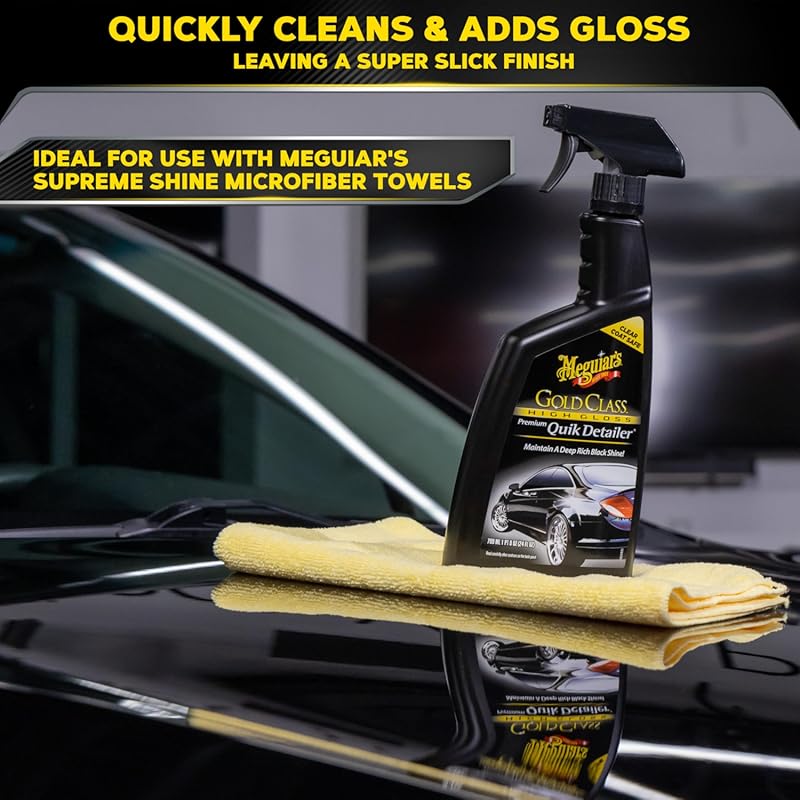
Meguiar's Gold Class High Gloss Quik Detailer (24 oz)
The dark-paint-focused detailer that also works on black engine components for a deep, rich appearance.
Standout features: - High-lubricity formula produces darker, richer appearance specifically on dark surfaces - Preserves existing protection while cleaning - Clear coat safe formula safe for all painted surfaces
At $8.97 for 24 oz with 2,682 reviews at 4.8 stars, the Gold Class Quik Detailer performs similarly to the standard Meguiar's product but with deeper appearance on dark surfaces. In engine bays, where most components are black plastic, rubber, or painted black metal, the depth-enhancing formula actually shows a visible difference.
For engine bay maintenance, this is a reasonable choice when you want components to have that deep factory-black appearance rather than just clean and dull. It's still a maintenance spray rather than a degreaser, with the same limitations for heavy grime. Check our Meguiars Detailer guide for a full breakdown of the Gold Class product family.
Pros: - Enhances depth on black engine bay components - Great value at $8.97 - 2,682 reviews at 4.8 stars - Safe for all surfaces
Cons: - Not a degreaser for heavy engine contamination - Dark-paint focus is less valuable on silver or chrome components - Smaller 24 oz format
Meguiar's D17001 Hyper Dressing (1 Gallon)
The professional-volume dressing that dilutes up to 4:1, giving you control over shine level from high gloss to satin.
Standout features: - Dilutes up to 4:1, giving you control over shine level - Works on tires, wheel wells, engine rubber, plastics, vinyl, and interior trim - Water-based formula with pleasant scent, safe to use
At $44.28 per gallon with 1,960 reviews at 4.8 stars, the Meguiar's Hyper Dressing is a professional-level product at a price that makes sense for high-frequency use. The dilution control is the standout feature. At 1:1 you get a high-gloss showroom shine. At 4:1 you get a natural satin appearance. Most engine bay detailers prefer somewhere in between.
The gallon format only makes sense if you're using this regularly across multiple vehicles or applications. For a homeowner doing their own car a few times a year, the 32 oz Hyper Dressing (B09NC3QY4L) is a better fit. The gallon is for professional detailers or shops doing multiple engine bays.
The versatility is genuinely useful. This product handles tires, wheel wells, interior trim, and engine bay components with a single formula. If you're running a detail operation and want to simplify your product inventory, one gallon handles multiple application categories. Check out Meguiars Ultimate Quik Detailer for the exterior detailer side of the Meguiar's lineup.
Pros: - 4:1 dilution control for adjustable shine level - 1,960 reviews at 4.8 stars - Covers engine, tires, wheel wells, and interior trim - Professional volume for high-frequency use
Cons: - Gallon format is overkill for personal vehicles - High upfront cost at $44.28 - Requires dilution management - Better alternatives exist for dedicated engine bay protection
Pig Spit Original 2-Pack (9 oz each)
The most versatile multi-surface detailer for engine bays, trim, tires, and vinyl, with a dedicated focus on restoring faded black plastic.
Standout features: - Multi-surface: cleans and shines metal, chrome, plastic, and painted surfaces simultaneously - Forms a protective barrier against dirt, road grime, and UV rays - Restores luster and shine to surfaces that have become dull from element exposure
The Pig Spit name is memorable, and the formula lives up to the branding. At $30.12 for a 2-pack (two 9 oz bottles) with 1,008 reviews at 4.8 stars, this is one of the most enthusiastically reviewed multi-purpose engine detailers in this space.
The spray-on application is simple: spray it on, wipe in with a clean cloth, buff to a shine. The protective barrier it forms helps engine components resist future grime adhesion, which reduces how often you need to detail. The UV protection is specifically useful for rubber hoses and plastic housings that degrade from UV exposure over time.
The limitation is size: two 9 oz cans go quickly if you're doing full engine bays regularly. The formulation works best on clean components rather than heavily greased surfaces, so plan to degrease first and use Pig Spit as the finishing protection step. Check out Meguiars Ultimate Detailer if you want to compare this against a more mainstream brand alternative.
Pros: - 1,008 reviews at 4.8 stars, strong performance validation - Multi-surface versatility covers the full engine bay - UV protection for rubber and plastic components - Two-pack provides a reasonable supply
Cons: - Two 9 oz cans aren't much product for the price - Spray-and-wipe formulation rather than a deep penetrating protectant - Not a heavy-duty degreaser
Griot's Garage Engine Bay Dressing (12.5 oz)
The dedicated engine bay dressing specifically formulated to restore a factory-fresh appearance without leaving a greasy, dust-attracting surface.
Standout features: - Revives dull engine bay surfaces to a clean, factory-new finish - Leaves a dry-to-the-touch finish that doesn't attract dust or grime - Safe for all materials and finishes inside the engine compartment
At $26.99 for 12.5 oz with 608 reviews at 4.8 stars, Griot's Garage Engine Bay Dressing earns the top spot on my list for dedicated engine bay protection. The "dry-to-the-touch" finish is the key differentiator.
Most engine dressings leave a greasy, shiny film. This looks great immediately after application but attracts dust, grime, and debris like a magnet. Within a few weeks, the greasy surface is dirtier than before you started. Griot's formula creates a factory-appearance finish that doesn't attract contamination.
For a clean engine that you want to maintain without constantly re-detailing, this is the product. Apply it after a thorough cleaning, let it dry, and the engine bay stays cleaner for longer between sessions. This is the approach professional detailers use before vehicle inspections and sales.
The 12.5 oz format is adequate for 2-4 engine bay applications depending on the vehicle size. The price is premium for the quantity, but the specific formulation for engine bays justifies it compared to general-purpose dressings.
Pros: - Dry-to-the-touch finish doesn't attract dust like greasy formulas - Factory-appearance restoration rather than flashy shine - Safe for all engine bay materials - 608 reviews at 4.8 stars
Cons: - Small 12.5 oz format for the price - $26.99 is premium for a specialty product - Dry finish may look less impressive immediately after application vs. Greasy alternatives
KOCHCHEMIE Motorplast (500 mL)
The German-engineered engine protectant with a permanently elastic film that defends against corrosion and environmental damage.
Standout features: - Permanently elastic protective film protects engine components and power units from corrosion - Water-displacing formula removes moisture from electrical components and metal surfaces - Natural shiny finish with pleasant fruity fragrance
At $23.99 with 392 reviews at 4.8 stars, the KOCHCHEMIE Motorplast brings European engineering precision to engine protection. The "permanently elastic" film claim is meaningful: standard dressings form brittle films that crack over thermal cycling. An elastic film flexes with temperature changes without losing integrity.
The water-displacing property is useful in climates where moisture exposure is a concern. Rain intrusion into the engine bay, high-humidity environments, and winter driving all introduce moisture that can cause long-term corrosion on metal components and electrical connections. KOCHCHEMIE specifically addresses this.
The 500 mL format is practical for the application. Engine bay protectants cover large surface areas, and 500 mL provides 2-3 thorough applications depending on vehicle size.
The limitation is availability and brand familiarity. KOCHCHEMIE is a respected European brand less known in the US market. The product quality is high, but finding it quickly for replenishment is harder than grabbing a Meguiar's or Chemical Guys product.
Pros: - Permanently elastic film handles thermal cycling - Water-displacing for moisture protection - 392 reviews at 4.8 stars - KOCHCHEMIE engineering quality
Cons: - Less widely available than US-market brands - 500 mL only covers 2-3 applications - Import pricing at $23.99
Pig Spit Original Single (9 oz)
The single-can version of the Pig Spit detailer for smaller jobs or first-time trial.
Standout features: - Same versatile formulation as the 2-pack - Forms protective barrier against UV, dirt, and grime - Easy spray-on application for engine trim, tires, and vinyl
At $17.38 for a single 9 oz can with 248 reviews at 4.8 stars, the single Pig Spit is the trial purchase option. If you want to test this product before committing to the 2-pack, the single can is the right entry point.
At $17.38 for one can vs. $30.12 for two, the per-unit cost is roughly the same, so the 2-pack is better value if you're confident in the product. Buy the single only if you're uncertain whether this fits your detailing workflow.
Pros: - Single-can trial option - Same 4.8 star formula - Reasonable single-unit price
Cons: - Less cost-efficient than the 2-pack - Only 9 oz per can - 248 reviews vs. 1,008 for the 2-pack
Meguiar's Hyper Dressing 32 oz (DRTU17032)
The consumer-sized, ready-to-use version of the D17001 Hyper Dressing for personal vehicle use.
Standout features: - Pre-diluted, no mixing required, ready to use immediately - High shine on non-painted rubber, plastic, and vinyl - Multiple applications including tires, wheel wells, engine rubber, and plastics
At $24.99 for 32 oz with 194 reviews at 4.8 stars, the consumer-size Hyper Dressing is the practical choice for home detailers who don't need a gallon of product. Pre-diluted for ready-to-use application means no measuring or mixing, just spray and apply.
The 32 oz format is significantly more practical than the gallon for personal use. For tires, wheel wells, and engine bay dressing on a single vehicle quarterly, this lasts a year or more. The formula is the same quality as the gallon, just pre-diluted and convenient.
Pros: - Pre-diluted, no mixing required - 194 reviews at 4.8 stars - 32 oz is right-sized for personal vehicle use - Same Meguiar's formula quality
Cons: - More expensive per ounce than gallon format - Pre-diluted means no shine level adjustment - 194 reviews is modest
Chemical Guys Nonsense All-Purpose Cleaner (16 oz)
The odorless, colorless all-purpose cleaner that handles engine bay cleaning before you apply any dressing or protectant.
Standout features: - Odorless, colorless formula leaves no scent after application - Works on vinyl, rubber, plastic, carpet, upholstery, and engine bay surfaces - Rich foam enhances cleaning contact on textured surfaces
At $9.99 for 16 oz with 16,794 reviews at 4.7 stars, Chemical Guys Nonsense is the engine bay cleaner rather than the protectant. This is step one before any of the dressings above. If your engine bay has oil film, road grime, or grease buildup, you need to clean before you protect.
The odorless formula matters for engine bays specifically. Enclosed spaces under the hood can trap scents, and working around a strong-smelling cleaner for extended time is unpleasant. Nonsense removes contamination without leaving a chemical odor on components.
The massive review count confirms this is a proven all-purpose cleaner. At $9.99, it's the most affordable product in this guide and one of the most important for getting the engine cleaning sequence right. Clean with Nonsense, rinse thoroughly, dry, then apply Griot's Engine Bay Dressing or KOCHCHEMIE Motorplast.
Pros: - 16,794 reviews at 4.7 stars, massively proven - Odorless formula for enclosed engine bay work - Best price in the guide at $9.99 - Handles all engine bay surface types
Cons: - 16 oz goes quickly on large engine bays - Requires dilution for lighter cleaning tasks - Not a protectant, only a cleaner
Buying Guide: Engine Bay Detailing Step-by-Step
Safety First Let the engine cool completely before detailing. Spraying water or cleaner on hot components risks thermal shock. Disconnect the battery if using any water-based cleaners near electrical components. Cover air intakes and sensitive electronics with plastic bags.
Clean Before You Protect The order matters completely. Applying dressing over dirty components seals in grime and creates a surface that looks shiny but harbors contamination underneath. Use Chemical Guys Nonsense or a diluted all-purpose cleaner to remove all oil film, dust, and grease before any protectant goes on.
Greasy Finish vs. Dry Finish High-gloss greasy finishes look impressive immediately but attract dust within days. Dry-to-the-touch formulas like the Griot's Garage Engine Bay Dressing look less dramatic but stay cleaner much longer. Choose based on your priorities: immediate appearance vs. Longer-lasting cleanliness.
Rubber and Plastic Protection UV degradation is the primary enemy of rubber hoses and plastic housings. Protective dressings with UV inhibitors slow this process. Cracked rubber hoses and brittle plastic are expensive to replace. Keeping them conditioned with a quality dressing reduces premature failure.
Application Tools Use separate applicator pads for the engine bay to avoid contaminating your exterior detailing tools. Foam applicators work well for flat plastic and metal surfaces. Soft brushes help reach into tight areas around brackets and fittings.
FAQ
Is it safe to get water in my engine bay? Modern engines are designed to tolerate light water exposure (rain gets in there). That said, avoid direct streams at electrical connections, the air filter, and around the fuse box. Let the engine dry completely before starting after any wet cleaning.
How often should I detail my engine bay? Once or twice per year is typical for maintenance detailing. If you're preparing for a sale or car show, more frequent attention is warranted. Between dedicated sessions, spot-cleaning with a quick detailer spray handles light dust accumulation.
Will engine dressing damage rubber hoses? Most quality dressings are formulated to be safe for rubber. Avoid products with high petroleum solvent content, which can degrade rubber over time. Water-based formulas like the Meguiar's Hyper Dressing are safe on rubber and actually condition the material.
What's the best way to clean a heavily greased engine bay? Start with a diluted all-purpose cleaner like Chemical Guys Nonsense applied with a brush to loosen oil and grime. Let it dwell for a few minutes. Rinse carefully with low-pressure water, avoiding direct streams at electronics. Dry with compressed air if available, then apply protective dressing.
Can I use tire dressing on engine bay components? Some tire dressings work, but dedicated engine dressings like the Griot's Garage product are specifically formulated for the thermal demands of the engine environment. Tire dressings often aren't designed for the heat cycling that engine components experience.
Should I clay bar engine bay surfaces? Not typically. Clay bar is for painted exterior surfaces to remove embedded contamination. Engine bay cleaning with an APC and a brush is the standard decontamination method for engine components.
Conclusion
The engine bay sequence is: clean first, protect second. Start with Chemical Guys Nonsense for degreasing, then apply protection based on your preference.
For the protection step, the Griot's Garage Engine Bay Dressing is my top recommendation if you want a finish that stays clean longer. The dry-to-the-touch formula is the right choice for maintenance detailing.
If you want something more aggressive on corrosion protection, especially in humid or cold climates, KOCHCHEMIE Motorplast with its elastic protective film is the specialist choice.
The Pig Spit 2-Pack earns a strong recommendation for its versatility across engine, trim, tires, and vinyl, with 1,008 reviews at 4.8 stars backing it up.
For volume buyers or professional detailers, Meguiar's D17001 Hyper Dressing in the gallon format covers engine bays, wheel wells, and tires with a single adjustable-shine formula.