




Affiliate Disclosure: This article contains affiliate links. If you purchase through these links, I may earn a small commission at no extra cost to you.
Best Detail Buffer: 8 Car Polishers for Every Budget and Skill Level
Picking the wrong buffer is one of the most expensive mistakes in DIY detailing. A rotary polisher in unpracticed hands will burn through clear coat in seconds. A cheap random orbital that lacks power won't remove a scratch no matter how long you run it. Getting the right tool matters as much as the compound you're using.
This guide covers buffers for everyone from the weekend hobbyist who wants to remove some swirls to the serious enthusiast tackling full paint corrections. I've included corded rotary polishers, cordless random orbital options, a budget attachment for those who already own a drill, and a mini polisher for tight spots.
I evaluated motor power, speed range, ergonomics, and how each tool fits different experience levels. A beginner needs a forgiving dual-action design with good safety margins. An experienced detailer needs power and control. For context on the detailing process that precedes polishing, the guide on car detailing buffer options provides useful background.
Quick Picks
| Product | Best For | Price |
|---|---|---|
| DEWALT DWP849X | Best professional rotary polisher | $279.00 |
| Chemical Guys TORQX Kit | Best complete beginner kit | $309.99 |
| DEWALT DCM848B | Best cordless polisher | $286.95 |
| Seesii 1600W Rotary | Best value corded rotary | $49.99 |
| Fanttik P10 Pro Mini | Best mini polisher for tight spots | $69.99 |
Product Reviews
DEWALT DWP849X Buffer Polisher (7-inch/9-inch)
The DWP849X is the professional standard in corded rotary polishers, trusted by detailers and body shop techs for decades.
Standout features: - 12-amp motor with all ball-bearing construction and precision-cut steel gears - Variable speed 0-3,500 RPM with a large speed dial for easy adjustment - Soft-start reduces initial torque spike, protecting paint on startup
DEWALT's DWP849X is the benchmark rotary polisher. The 12-amp motor delivers consistent power through the entire speed range. The soft-start feature is important: it prevents the sudden initial grab that sends untrained operators spinning the pad across the panel edge.
At $279.00 with 6,851 reviews at 4.7 stars, this is a proven tool. The rubber over-moulded gear case doubles as a second grip point for two-handed control, which rotary polishers demand. You need to control the tool at all times. Careless technique burns paint.
The DWP849X is not a beginner buffer. If you're new to polishing, start with a random orbital. This tool belongs in the hands of someone who understands dwell time, pressure, and speed management for different paint hardnesses. For experienced operators, though, the cutting power is unmatched at this price point.
The variable trigger plus separate speed dial gives you two ways to control speed. The trigger controls initial power application; the dial sets your working range. That combination gives fine control during actual polishing work.
Pros: - Industry-standard tool with 6,800+ validated reviews - 12-amp power handles any correction job - Soft-start prevents initial tool grab
Cons: - Not suitable for beginners without supervision - No battery option, requires outlet or extension cord - Heavy at 7 pounds for extended polishing sessions
DEWALT DCM848B 20V MAX XR Cordless Polisher (5-inch)
The cordless evolution of DEWALT's polisher lineup, the DCM848B offers professional performance without the cord constraint.
Standout features: - Brushless motor for maximum efficiency and runtime - 2.1-inch orbit diameter with 5-inch backing plate - Variable speed 2000-5500 OPM via trigger and dial
Freedom from the cord matters when you're working your way around a full vehicle. The DCM848B runs on DEWALT's 20V MAX battery system, which means if you already have DEWALT batteries from other tools, the entry cost drops significantly. The tool is sold without a battery, so that's an important cost consideration.
The brushless motor delivers better runtime than brushed alternatives and the 2.1-inch throw on the random orbit is the sweet spot for general paint correction. Too small and you lose coverage speed. Too large and the machine becomes harder to control.
At $286.95 with 1,257 reviews at 4.7 stars, this is priced alongside the DWP849X but offers the dual-action safety margin that forgives minor technique errors. For a car paint buffer that you can use anywhere without extension cord management, this is the top choice.
The random orbit action means it won't burn paint the way a rotary will. You sacrifice some cutting aggression but gain significant safety margin. For most DIY enthusiasts doing light to moderate paint correction, that trade-off is worthwhile.
Pros: - Cordless freedom with DEWALT battery compatibility - Brushless motor for runtime efficiency - Dual-action design is safer for less experienced users
Cons: - Sold tool-only, battery adds $50-100 to the total cost - Less cutting power than the corded DWP849X - 5-inch backing plate limits speed on large panels
Milwaukee Cordless Polisher (M18)
Milwaukee's M18 platform polisher offers professional reliability and excellent ergonomics for detailers already in the Milwaukee ecosystem.
Standout features: - 827 reviews at 4.7 stars - Compatible with M18 battery platform - Random orbital design appropriate for detailing work
Milwaukee's tool quality is consistently strong across their M18 lineup. At $169.00 for the tool only, this is the most affordable of the three major cordless options. If you already have M18 batteries from other tools, the effective cost is just $169.
The product listing information is limited compared to the DEWALT options, which makes detailed specifications harder to confirm. Milwaukee's reputation carries significant weight here. Their battery runtime is competitive, and their motor construction is professional-grade.
The 4.7 stars from 827 reviews is solid validation. For someone building a M18 tool collection or specifically preferring Milwaukee's ergonomics, this is the right pick over the DEWALT DCM848B.
Pros: - Lowest tool-only price among professional cordless options - M18 battery compatibility for existing Milwaukee users - Strong brand reliability
Cons: - Limited specification information available - Sold tool-only, battery adds significant cost - Less documentation of orbit diameter compared to DEWALT
BLACK+DECKER MATRIX Buffer Attachment (BDCMTBFF)
A buffer attachment for the BLACK+DECKER MATRIX system, this is the most accessible entry point for anyone who already owns a compatible MATRIX power unit.
Standout features: - Compatible with MATRIX 20V power units - Quick-connect attachment change system - Cordless via existing MATRIX battery platform
At $49.99, the BDCMTBFF is a budget-accessible way to add buffing capability to an existing MATRIX tool set. The 101 reviews at 4.7 stars is reasonable validation for what is fundamentally a niche attachment product.
The honest assessment: this is not a dedicated detailing polisher. It's a versatile tool attachment that performs buffing duties adequately for light waxing and polish application. The MATRIX system's power output is lower than dedicated polishers, which limits cutting ability. You won't be removing deep scratches with this.
For light waxing, maintenance polish application, and gloss enhancement on well-maintained paint, this works fine. For anyone who already owns the MATRIX power unit, it's a cost-effective way to occasionally buff a car without buying a dedicated machine.
As a standalone detailing tool, a dedicated detailing buffer is a better long-term investment.
Pros: - Extremely affordable for existing MATRIX users - Quick-connect system makes switching attachments effortless - Cordless convenience for light detailing tasks
Cons: - Limited power compared to dedicated polishers - Not suitable for actual paint correction - Requires compatible MATRIX power unit to function
Fanttik P10 Pro Mini Car Buffer Polisher
A purpose-built mini polisher for tight areas, the Fanttik P10 Pro addresses the spaces that standard 5-inch machines can't reach.
Standout features: - Weighs only 0.58 lbs, 2-inch and 3-inch backing plate options - 4000mAh battery for up to 50 minutes runtime - Planetary gear system runs at 65 dB maximum noise
Side mirrors, door handles, emblems, bumper corners, A-pillar trim areas. These spots see contamination and swirls just like the main body panels, but a standard dual-action machine won't fit. The Fanttik P10 Pro fills that gap with a dedicated mini polisher designed for precision work.
At $69.99 with 35 reviews at 4.7 stars, this is a specialized tool with a reasonable price. The 4000mAh battery gives 50 minutes of continuous runtime, which is enough for thorough detail work on a full vehicle's accent areas.
The Type-C fast charging is convenient. No proprietary charging blocks or hard-to-replace batteries. The quick-change backing plate system accommodates 2-inch and 3-inch pads for different applications. Sandpapers, polishing pads, and a cleaning brush are included.
For a complete detailing toolkit, the P10 Pro pairs naturally with a full-size dual-action polisher for the main panels. This fills the last gaps.
Pros: - Fills the niche for tight spaces that full-size polishers can't reach - Long 50-minute battery runtime - Universal Type-C charging
Cons: - Not a replacement for a full-size polisher on main panels - 35 reviews is still building for a newer product - Small pad diameter limits coverage on flat surfaces
Seesii 1600W Car Buffer Polisher
A 1600W corded rotary polisher with 7 variable speeds and ergonomic dual-handle design, the Seesii offers rotary power at a fraction of the DEWALT's price.
Standout features: - 1600W copper core motor with 2056-3600 RPM range - Detachable D-handle and side handle for two-handed control - Speed lock button for maintaining speed on large surface areas
At $49.99 with 18 reviews at 4.7 stars, the Seesii is an interesting option for budget-conscious buyers who want rotary power. The 1600W copper motor is the key spec. Copper motor windings run cooler and more efficiently than aluminum alternatives, which matters for extended polishing sessions.
The 7-speed adjustment and detachable handle design show genuine thought about usability. The speed lock button is a practical feature for large panels where you want consistent speed without finger fatigue.
My concern is the review count. 18 reviews is very limited for a tool that generates significant heat and requires precise motor control. The manufacturer recommends a 10-minute cool-down every 30 minutes, which is honest about the thermal limits of a $49.99 motor.
For occasional use by someone comfortable with rotary polishers, this is a cost-effective option. For regular professional use, invest in the DEWALT.
Pros: - Very affordable rotary power - Copper core motor for better heat dissipation - Speed lock is a useful feature for large panel work
Cons: - Only 18 reviews, insufficient validation for a tool this powerful - Requires cool-down every 30 minutes - No soft-start, higher risk of initial grab
Dobetter 1500W Car Buffer Polisher with LCD Display
A 1500W rotary polisher that adds an LCD display showing real-time RPM, the Dobetter offers precise speed monitoring in an affordable package.
Standout features: - LCD display showing exact RPM with ±1% accuracy - Constant speed technology maintains preset RPM within ±15 RPM under load - 6-speed range from 1000 to 3500 RPM with 4-meter cord
The LCD display is a genuinely useful feature. Most rotary polishers use a mechanical dial with approximate speed positions. Knowing your exact RPM matters when following compound and polish manufacturer recommendations.
The constant speed technology is impressive for a $43.99 machine. Standard motors slow down under polishing pressure, which leads to inconsistent results. The active current regulation maintains speed even as pad pressure varies.
17 reviews at 4.7 stars is limited. The brand is not widely established. The features, however, are legitimately useful for someone who wants data-driven control over their polishing work.
Pros: - LCD display provides precise RPM feedback - Constant speed technology for consistent results - Long 4-meter cord eliminates most extension cord needs
Cons: - 17 reviews is too limited for confident recommendation - Unknown brand reliability compared to DEWALT - 1500W rating may not reflect sustained output under load
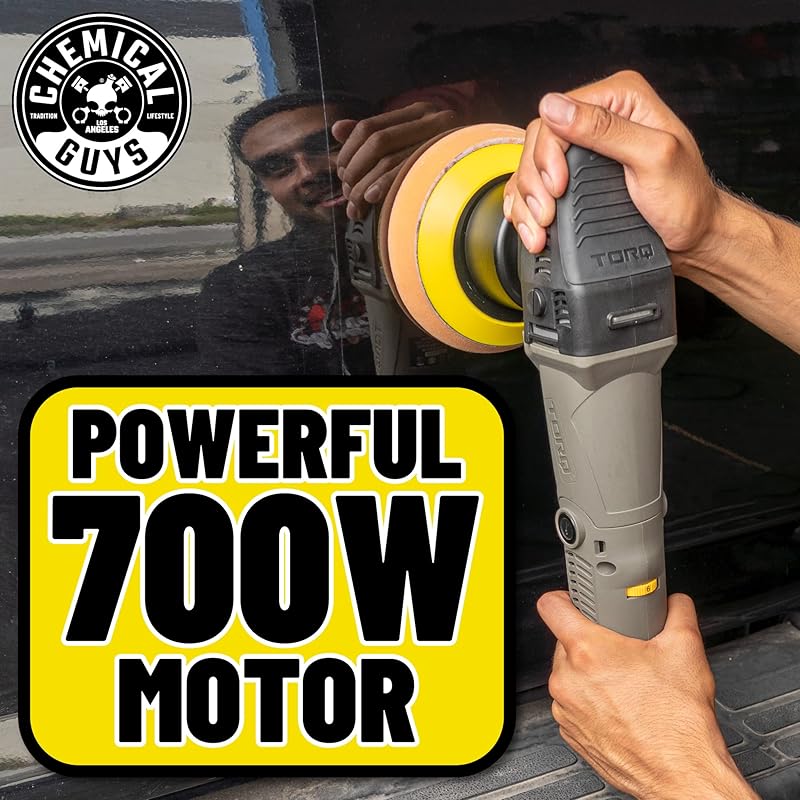
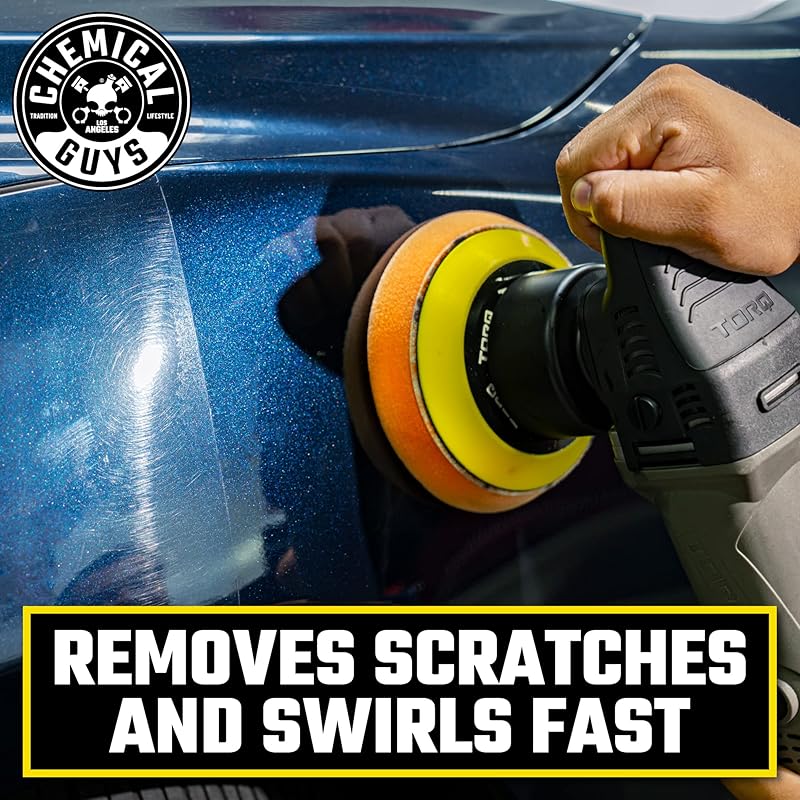
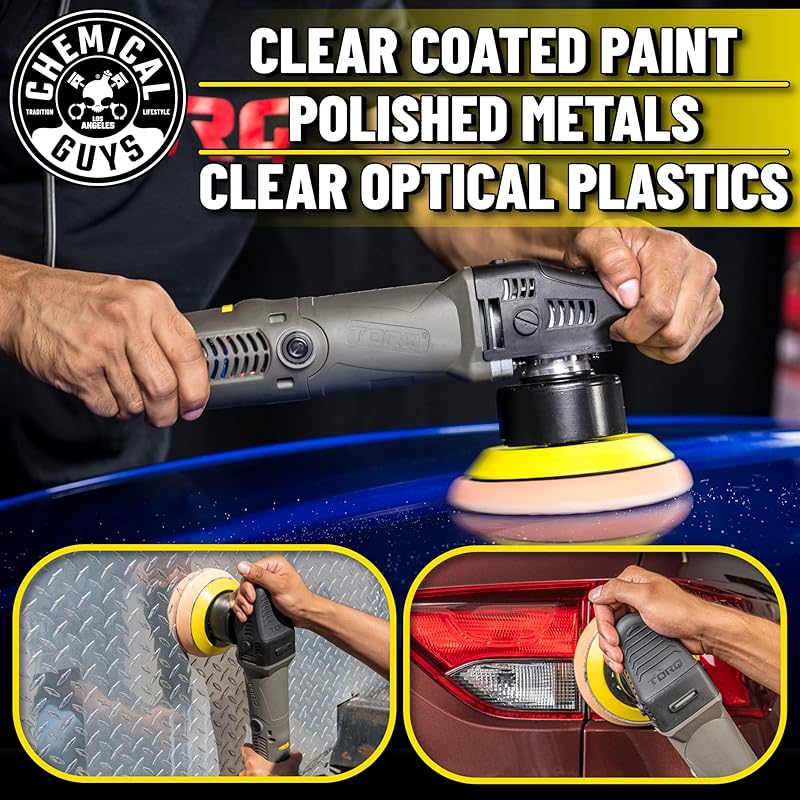
Chemical Guys TORQX Dual-Action Random Orbital Polisher Kit (13-Piece)
The most comprehensive beginner detailing kit in this roundup, the TORQX comes with everything needed to start correcting and protecting paint.
Standout features: - 6,414 reviews at 4.6 stars, strongest validation in this roundup - 13-piece kit includes polisher, multiple pads, towels, and Arsenal Range Bag - Dual-action design minimizes risk of paint damage for beginners
At $309.99, the TORQX kit is the most expensive option in this roundup but also the most complete. You're getting a polisher, a set of cutting, polishing, and finishing pads, microfiber towels, and a properly organized detailing bag. Buying those items separately would cost significantly more.
The dual-action random orbital design is the right starting point for beginners. The machine oscillates on two axes simultaneously, which makes it nearly impossible to create the swirls, holograms, and heat damage that a rotary polisher can produce in untrained hands. You sacrifice some raw cutting power but gain significant safety margin.
The 6,414 reviews at 4.6 stars is the strongest real-world validation in this roundup. Chemical Guys has sold this kit in massive quantities, and the rating has held. That means real users are achieving real results with it.
For anyone wanting a car wax buffer with everything included to start from nothing, this kit is the right call.
Pros: - Complete kit reduces barriers to entry - Massive review count validates real performance - Dual-action design appropriate for beginners and enthusiasts
Cons: - Most expensive option at $309.99 - Some users find pads and chemicals in the kit redundant if they have supplies - Slightly less cutting power than dedicated rotary polishers
Buying Guide: Choosing the Right Detail Buffer
Rotary vs. Dual-Action: Know the Difference
Rotary polishers spin on a single axis at high speed. They generate significant heat and cut aggressively. They correct deep scratches fast. They also burn clear coat in seconds if you're not careful. Dual-action random orbital polishers oscillate on two axes simultaneously, generating less heat, cutting less aggressively, and forgiving technique errors. Beginners should always start with dual-action.
Corded vs. Cordless
Corded polishers deliver consistent power regardless of battery state and eliminate charging time. Cordless polishers offer freedom to work around the vehicle without dragging a cord or using an extension. For a home detailer with a garage outlet nearby, corded is simpler. For mobile detailers or those who value cord-free work, cordless is worth the battery cost.
Speed Range and Control
More speed options mean more flexibility for different compounds, pads, and correction stages. Slow speeds (1000-1500 RPM) are for wax application and delicate surfaces. Medium speeds (2000-3000 RPM) cover most polishing work. High speeds (3000+) are for aggressive compound cutting on hard paint. Look for tools with fine-grained control across that range.
Orbit Diameter (Dual-Action Only)
Orbit diameter refers to how far the pad travels on the secondary oscillating axis. Smaller orbits (5mm-12mm) are more precise and appropriate for tight areas. Larger orbits (15mm-21mm) cover more area per pass and cut more aggressively. DEWALT's 2.1-inch (approximately 53mm) orbit is on the larger end, which is good for open body panels.
Motor Power and Sustained Output
Marketing wattage figures can be misleading. A 1600W motor that requires cooling breaks every 30 minutes has lower practical output than a 12-amp corded machine that runs all day. Look for brands with proven track records and pay attention to thermal management details in product descriptions.
FAQ
What's the difference between a buffer and a polisher?
The terms are often used interchangeably, but technically a buffer operates at lower speeds for wax application and buffing, while a polisher operates at higher speeds for compound and polish work. Most machines on this list can do both tasks across their speed range.
Can a beginner safely use a rotary polisher?
With proper technique training, yes. Without it, absolutely not. Rotary polishers burn clear coat fast on thin spots, edges, and high ridges. Start with dual-action. Graduate to rotary only after understanding speed, pressure, and dwell time management.
What pads should I use with my buffer?
Cutting pads (foam or microfiber) for heavy compound work. Polishing pads for medium correction. Finishing pads for final polish or wax application. The aggressiveness of the pad and product work together. Heavy cutting pad plus light polish doesn't accomplish much. Finishing pad plus heavy compound overheats and burns paint.
How much pressure should I apply with a dual-action polisher?
Generally 5-10 lbs on the pad, letting the machine do the work. Excessive pressure on a dual-action causes the orbital motion to stop and the pad to spin like a rotary, increasing heat and risk. You'll feel the machine bog down. Back off when that happens.
Do I need a polisher to apply wax or ceramic coating?
No. Wax and ceramic coatings are applied by hand using foam applicators. A polisher helps you remove scratches before applying protection but is not required for the application step itself.
How do I clean polishing pads after use?
Foam pads: rinse with warm water and mild soap, work compound out of the foam by hand, then air dry. Never machine wash. Microfiber pads: machine wash in cold water without fabric softener, air dry. Clean pads after every use to prevent compound buildup from affecting future polishing passes.
Conclusion
For serious paint correction work, the DEWALT DWP849X remains the professional standard. If you want cordless freedom at professional quality, the DEWALT DCM848B is the right call.
For beginners or anyone wanting a complete kit to start with, the Chemical Guys TORQX 13-piece kit at $309.99 removes every barrier. Everything you need is in one box.
Budget buyers who want real rotary power should look at the Seesii 1600W at $49.99. The review count is limited but the specs are reasonable for occasional use.
Whatever machine you pick, practice on a test panel before touching a panel you care about. Technique matters more than the tool.