

Disclosure: This article contains affiliate links. If you purchase through these links, I may earn a commission at no extra cost to you.
Best Ceramic Coating for RVs: Protect Your Investment on Every Road
An RV is a fundamentally different beast to protect compared to a car. The surface area is enormous, you're dealing with fiberglass, aluminum, and rubber roof in some combination, and the vehicle spends months parked in UV exposure that would destroy untreated surfaces. Standard car wax isn't enough. You either invest in ceramic protection or you watch your clearcoat oxidize and your fiberglass chalk.
This guide is for RV owners who want to extend the life of their vehicle's exterior, reduce maintenance time between trips, and protect a significant financial asset. I've evaluated products on RV-specific criteria: large surface coverage, ease of application at scale, compatibility with fiberglass and aluminum, and UV resistance for extended sun exposure.
The budget reality with RVs is that product quantity matters. If you're coating a 36-foot Class A, a 30ml bottle won't cut it. I've noted volume and coverage information for each product where available.
Quick Picks
| Product | Best For | Price | Rating |
|---|---|---|---|
| Glidecoat Alpha Graphene Ceramic | Best pro-level RV-specific coating | $67.15 | 4.8★ |
| CLEAN. Ceramic Coating 8-Year | Best hard coat for long-term protection | $149.99 | 5★ |
| Chemical Guys HydroSuds Ceramic Wash | Best ceramic-infused wash soap for maintenance | $46.99 | 4.7★ |
| Griot's Garage Ceramic 3-in-1 Wax | Best spray option for regular upkeep | $21.99 | 4.7★ |
| Turtle Wax Hybrid Solutions Ceramic Spray | Best budget entry point | $14.99 | 4.6★ |
Individual Product Reviews
Glidecoat Alpha Graphene Ceramic Coating
A pro-level coating explicitly designed for marine, automotive, and RV applications.
Standout features: - Marine-grade protection formulation that handles constant UV exposure and environmental contamination - Graphene-enhanced chemistry for improved durability and hydrophobics over standard SiO2 coatings - 5-year rated protection window with a single application
Glidecoat Alpha is the only product in this roundup built with marine and RV surfaces specifically in mind. Marine-grade chemistry is meaningful: boats face constant UV, salt, water exposure, and temperature swings. RVs face similar stresses, so a product proven on marine fiberglass translates directly.
The graphene formula is an upgrade over traditional SiO2. Graphene coatings generally resist heat better, reduce water spotting, and maintain hydrophobicity longer under harsh conditions. For an RV parked in Arizona summers or driven through mountain weather cycles, those properties matter more than they would on a garage queen.
At $67.15, the Alpha isn't cheap, but it's positioned as a professional coating. The 4.8 rating across 12 reviews is strong, though the review count is limited. The broader Glidecoat brand has a solid reputation in the marine detailing community, which provides some additional confidence.
For a full-size RV, you may need more than one unit. Plan for 2-3 applications worth of product for a Class A or large Class C.
Pros: - Purpose-built for RV and marine surfaces including fiberglass - Graphene formula outperforms standard SiO2 in UV resistance - 5-year protection window is respectable for a single application
Cons: - Limited review count to validate long-term performance - Coverage for large RVs will require multiple units, increasing cost - Pro-level product requires proper prep work to achieve rated durability
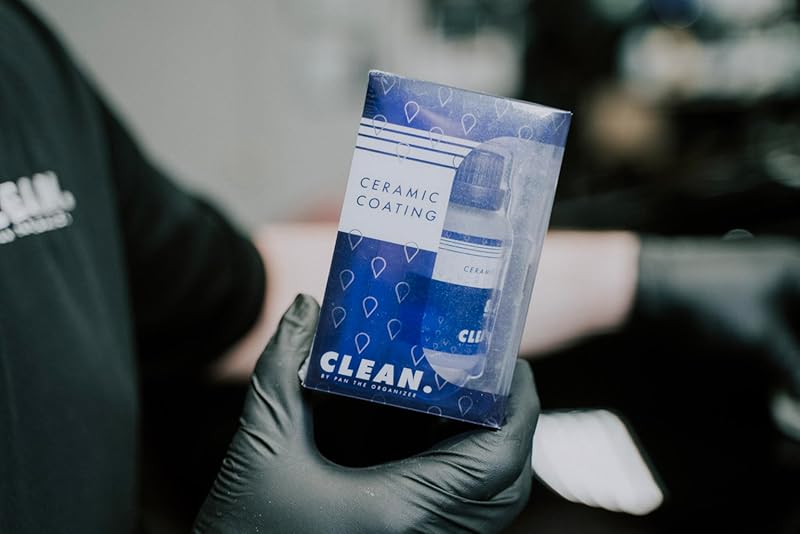
CLEAN. Ceramic Coating 8-Year
The highest-rated hard coat in this roundup, with 8-year protection for serious applications.
Standout features: - 8-year durability claim backed by a high-solids professional formulation - Handles the full pH range (1-14), meaning bird droppings, tree sap, and road chemicals won't penetrate - Safe for all exterior surfaces including fiberglass, glass, trim, and aluminum
The CLEAN. 8-Year is the most ambitious consumer ceramic coating available at this price point. At $149.99 for 30ml covering two cars (or roughly one full RV exterior if applied carefully), it's the serious investment pick.
For an RV, the chemical resistance is particularly valuable. RVs park under trees for extended periods, collect pine sap, bird waste, and road grime without the frequent wash cycle a daily driver gets. A coating that actively resists pH extremes (1-14 covers virtually everything you'd encounter) provides genuine passive protection.
The surface versatility is worth noting: fiberglass sides, aluminum trim, rubber seals, and glass windows all benefit from the same application. Understanding the ceramic coating cost for professional applications ($1,000-3,000+ for a large RV) makes this $150 DIY option look very attractive.
Caveats: application prep on an RV requires more time than a car. Surface decontamination, especially on older RVs with oxidized fiberglass, is work. Budget a full day for a thorough job.
Pros: - 8-year protection is the longest-rated option here - Full chemical resistance (pH 1-14) handles diverse environmental exposure - Covers two standard-size vehicles per 30ml
Cons: - Full-size RVs may need more than one bottle depending on condition and application thickness - Requires significant prep work on oxidized or neglected RV surfaces - Price is high if you're unsure about your application technique
Hatinix 20H Graphene Ceramic Coating (70ml)
A value-positioned graphene hard coat with unusually high active content for the price.
Standout features: - 82% active content, genuinely high for a sub-$60 hard coat product - 70ml bottle provides more working material than competitors at this price - Graphene technology adds heat resistance and reduced water spotting vs. Standard SiO2
At $49.99 for 70ml, the Hatinix 20H makes graphene technology accessible for RV owners who want an upgrade from standard SiO2 sprays but aren't ready to invest in professional-level coatings.
The 10-year protection claim should be taken as an optimistic ceiling. In RV applications, where vehicles face sustained UV exposure and aren't garaged, realistic durability at 3-5 years with proper maintenance is the more honest expectation. Still, that's strong performance for a $50 product.
The volume advantage over the CLEAN. 3-Year (70ml vs 30ml) means you have more material to work with on larger surfaces, which matters when you're covering fiberglass panels measured in square feet rather than inches.
Pros: - Most material per dollar among the hard coat options - Graphene chemistry is genuinely better for UV-heavy environments - Self-cleaning effect reduces how often you need to wash your RV
Cons: - 10-year claim is ambitious, especially for hard-use RV applications - 26 reviews means less validated long-term feedback - Application still requires prep and careful panel-by-panel technique
CLEAN. Ceramic Coating 3-Year
The more accessible option from CLEAN., with a 1-hour water readiness that's practical for field applications.
Standout features: - Ready for rain or wash in just 1 hour post-application - Full chemical resistance established in 7 days - Matte-safe formula works on gel-coat and specialty finishes
For RV owners who detail at campgrounds or storage facilities where weather is unpredictable, the 1-hour water readiness is practically important. The 8-year version requires longer initial protection from moisture.
At $99.99 for coverage of two vehicles worth of surface area, the 3-year version hits a reasonable middle ground. It's real hard coat chemistry without the price or cure time demands of the premium version.
Pros: - Fastest water readiness among hard coats in this list (1 hour) - Matte-safe for RVs with specialty exterior finishes - Solid mid-tier price point
Cons: - 3 years is shorter than alternatives at similar or lower prices - Only 18 reviews makes performance validation limited - Still requires decontamination prep
GLOWPOINT 20H Graphene Ceramic Coating (70ml)
The most budget-friendly graphene hard coat option with a complete DIY kit.
Standout features: - Includes applicator sponge and microfiber towel, everything needed to start - 70ml at $36.99 is the lowest price per volume for a graphene ceramic - Simple 4-step process designed for first-time applicators
For RV owners new to ceramic coating, the GLOWPOINT package eliminates the need to buy separate applicator pads and microfibers. At $36.99, the barrier to entry is the lowest among hard coats here.
I'd temper expectations for a $37 product claiming 10-year protection on a large RV. This is better suited as a starter product to understand the application process, or for use on a smaller Class B van where the surface area is manageable. For a 40-foot Class A, you'd need multiple units and the value proposition shifts.
Pros: - Complete kit included - Lowest price among graphene hard coats - Beginner-friendly application process
Cons: - Small review base (10 reviews) - Less credibility for 10-year claims versus higher-priced competition - Multiple units needed for large RVs increases total cost
Technicians Choice TEC582 Ceramic Detail Spray (1 Gallon)
A gallon of professional-grade SiO2 detail spray at a price that scales well for RV maintenance.
Standout features: - 1 gallon at $25.99 covers an enormous amount of surface area across multiple sessions - Works on every exterior surface: fiberglass, glass, plastic trim, chrome, aluminum - 3,011 reviews at 4.8 stars is one of the most validated products here
For RV maintenance specifically, the gallon format of TEC582 makes more sense than for a regular car. You have a lot of surface to cover. Using this as a monthly or quarterly maintenance spray between ceramic coating applications is exactly the right use case.
The economics work out well: $26 for a gallon of high-quality SiO2 detail spray that lasts many months of applications. Professional detailers use products like this because the value-per-ounce is exceptional.
The car ceramic coating cost for professional RV applications routinely exceeds $2,000. Using TEC582 as a maintenance layer between periodic ceramic applications stretches the investment considerably.
Pros: - Gallon size is ideal for large RV surfaces - 4.8 stars across 3,000+ reviews is exceptional validation - Compatible with all exterior surface types on an RV
Cons: - SiO2 spray, not hard coat; needs regular reapplication - Won't prevent oxidation over the long term without an underlying hard coat - Gallon may be overkill for small RVs or occasional users
Chemical Guys HydroSuds Ceramic SiO2 Wash Soap (64 oz)
A ceramic-infused wash soap that adds protection with every wash, ideal for RV maintenance.
Standout features: - SiO2 polymers bond to paint during washing, boosting protection without an extra step - Works in foam cannons, hose foam blasters, and bucket wash setups - 7,142 reviews at 4.7 stars is excellent validation for a wash soap
HydroSuds takes a clever approach: instead of applying ceramic protection as a separate step, you build it into your regular wash routine. For RV owners who wash their rig multiple times per season, that adds up.
The foam cannon compatibility is particularly relevant for RVs. Reaching the roof and upper sides of a 40-foot coach requires standing on a ladder or using an extension. A foam cannon that can reach 12+ feet makes the process safer and faster. HydroSuds' thick suds cling to the surface long enough for the ceramic polymers to work, even in vertical applications.
At $46.99 for 64 oz, this is good value for a product you'll use regularly. It's also the most practical way to maintain ceramic protection between full coating applications.
Pros: - Builds ceramic protection into every wash without extra steps - Foam cannon compatible, practical for tall RV sides and roof - 7,000+ reviews validates real-world effectiveness
Cons: - 64 oz disappears faster than you'd expect with frequent RV washing - SiO2 wash soap provides lighter protection than a dedicated coating - Berry scent is pleasant but may not appeal to everyone
Griot's Garage Ceramic 3-in-1 Wax (22 oz)
A versatile spray wax for regular RV maintenance between ceramic coating applications.
Standout features: - Specifically marketed for cars, trucks, and RVs (listed on the label) - Works on paint, plastic trim, rubber, and chrome in one product - Made in the USA, 3,221 reviews at 4.7 stars
The 3-in-1 label covers a legitimate multi-surface capability. An RV exterior has fiberglass sides, plastic bumpers, rubber window seals, chrome accents, and aluminum trim. Using a single product across all of them saves time and reduces risk of applying the wrong product to the wrong surface.
The spray-on wipe-off application is quick enough to use as part of a campground cleanup routine. Spray the sides, wipe down, done. It won't match a hard coat's durability, but used monthly or after each trip it maintains a clean, hydrophobic surface.
Pros: - Explicitly designed for RV use, not just re-marketed car product - Single product covers all RV exterior surface types - Quick spray application suits on-the-road maintenance
Cons: - Wax-based protection is shorter-lived than ceramic hard coats - 22 oz goes quickly on a large RV, multiple bottles needed per application - Matte surfaces require checking compatibility with hybrid wax products
Turtle Wax Hybrid Solutions Ceramic Spray Coating (16 oz)
The highest-reviewed ceramic spray at a price that removes all excuses for not protecting your RV.
Standout features: - 28,293 reviews at 4.6 stars, more feedback than any other product in this guide - Safe for glass, wheels, plastic trim, and rubber surfaces - Can be applied in direct sunlight
At $14.99, the Turtle Wax Hybrid Solutions is the entry point for anyone hesitant to invest in ceramic protection for their RV. The validation at 28,000+ reviews means the formula genuinely works for a wide range of users and conditions.
For a large RV you'll need multiple bottles per application, which reduces the cost advantage. But as a maintenance spray or a gateway product for first-time ceramic users, the price and validation are unbeatable.
Pros: - Most user reviews of any ceramic product available - Extremely accessible price point removes financial risk - Sunlight-safe application is practical for outdoor RV work
Cons: - Multiple bottles needed for large Class A or C coaches - Protection duration is limited compared to hard coat options - Not a substitute for a proper ceramic coating on a valuable RV
Meguiar's Ultimate Ceramic Coating Kit
A professional-style kit from one of the most recognized names in detailing.
Standout features: - Includes two premium microfiber towels, so you have everything needed for application - Spray-spread-wipe application is one of the more user-friendly processes among hard-coat adjacent products - 685 reviews at 4.6 stars with a trustworthy brand behind it
Meguiar's bridges the gap between true hard coats and spray coatings. It's not as durable as the CLEAN. Products, but the application process is significantly easier. Spray on, spread with one microfiber, buff off with another. For a first-time RV detailer not ready to tackle a full hard coat application, this is a logical step up from Turtle Wax.
At $20.17 with towels included, the value is good. Meguiar's also claims it conceals minor paint defects while coating, which can help on older RV fiberglass with light surface marring.
Pros: - Includes microfiber towels, no additional purchase needed - Trusted Meguiar's brand with established performance history - Conceals minor surface defects during application
Cons: - Not as durable as true hard coat ceramics - 685 reviews is smaller sample than I'd prefer for a significant investment - Price doesn't reflect as much product as some competitors
Buying Guide: What RV Owners Need to Know
Surface Compatibility is Non-Negotiable
RVs have diverse exterior surfaces: fiberglass gel coat, aluminum sheets, rubber seals, plastic trim, and sometimes specialty graphics. Not every product is safe on all of these. Verify compatibility before applying anything to your rubber roof or specialty graphics panels.
Volume Planning
A standard car needs roughly 30-50ml of hard coat for a full application. A Class C RV might need 3-4 times that. A large Class A can require significantly more. Calculate how much product you need before purchasing and whether the economics still make sense.
UV Protection Matters More for RVs
A garage queen car and a full-time travel RV face completely different UV exposure. If your RV lives in the sun for months at a time, UV resistance should be your primary buying criterion. Graphene coatings and high-solids formulas are your best defense.
Understanding Actual vs. Professional Costs
Car ceramic coating cost for a large RV runs $1,500-3,500 professionally. Even the most expensive DIY product on this list costs a fraction of that. Factor in your time, but the financial case for DIY RV ceramic coating is strong.
Maintenance Protocol
A ceramic coating isn't a one-and-done solution. Even an 8-year hard coat benefits from regular pH-neutral washes and occasional ceramic booster applications. Building a maintenance routine with a product like HydroSuds or the TEC582 spray extends coating performance significantly.
Frequently Asked Questions
Can you put ceramic coating on an RV fiberglass exterior? Yes. Fiberglass is one of the best surfaces for ceramic coatings. The smooth gel coat surface bonds well with SiO2 and graphene formulas, and the protection against UV-induced oxidation and chalking is significant.
How much does it cost to ceramic coat an RV professionally? Professional ceramic coating for a Class A RV typically runs $1,500-3,500 depending on size, condition, and coating tier. Understanding cost for ceramic coating options helps you compare DIY vs. Professional approaches.
How long should ceramic coating last on an RV? Hard coat ceramics should last 3-8 years with proper maintenance. Spray coatings last weeks to a few months. Realistic expectations for a high-UV environment: 3-5 years for a quality hard coat.
Do I need to polish my RV before applying ceramic coating? If the fiberglass is oxidized or has surface scratches, yes. Polishing before coating ensures the protective layer bonds to clean, corrected paint rather than sealing in damage.
What's the best ceramic coating for an older RV with oxidized gel coat? Address the oxidation first with a quality compound and polish. Then apply a hard coat ceramic. Applying ceramic over uncorrected oxidation will lock in the damage and reduce coating adhesion.
Can ceramic coating go on RV decals and graphics? Most ceramic sprays are safe on vinyl graphics, but verify with the specific product before applying a hard coat over delicate decals. Griot's 3-in-1 and the Turtle Wax spray are generally safe options.
Conclusion
For a serious RV that sees significant seasonal use and sun exposure, the Glidecoat Alpha Graphene is my top pick specifically because it was engineered for marine and RV applications, not just re-marketed car product. The graphene chemistry handles the demanding UV environment that RV exteriors face.
If budget is the primary concern, the CLEAN. Ceramic Coating 8-Year at $149.99 offers the best long-term protection among consumer hard coats. For two-vehicle coverage, the per-unit cost is competitive with professional options.
For ongoing maintenance between hard coat applications, the Chemical Guys HydroSuds foam soap adds ceramic protection with every wash, which is the most time-efficient way to maintain a large RV exterior. Combine a hard coat with regular HydroSuds washes and you have a comprehensive protection system.
Want to compare professional coating options to DIY? Check out our car ceramic coating near me guide for what professional installers can offer.