







Affiliate disclosure: This article contains affiliate links. If you buy through our links, we may earn a commission at no extra cost to you.
Best Car Buffer Waxer: 9 Machines for Flawless Results
A car buffer waxer bridges two jobs: removing light defects and applying protection. You don't necessarily need separate tools for polishing and waxing if your machine handles both. The right buffer waxer smoothly transitions from a light polish to a sealant or wax application by simply swapping the pad.
This guide covers nine machines worth considering, from under $50 budget options to professional corded machines that cost $279. I've focused on real-world trade-offs rather than spec sheet comparisons. Who each machine is actually for, what its limits are, and whether the price makes sense for what you get.
If you're also looking for guidance on what compounds and waxes to pair with these machines, check out the car wax buffer section and the detailed car detailing buffer category.
Quick Picks
| Product | Best For | Price |
|---|---|---|
| DEWALT DWP849X | Professional rotary correction and waxing | $279 |
| Chemical Guys TORQX Kit (9-piece) | Complete beginner setup | $220 |
| Chemical Guys TORQX Solo | Best value DA for DIYers | $155 |
| PORTER-CABLE 7424XP | Reliable DA at mid-range price | $159 |
| Seesii 1600W Rotary | Budget rotary power for experienced users | $50 |
Product Reviews
DEWALT Buffer Polisher DWP849X, 7-in-9-in, 12 amp
The professional corded rotary that sets the standard for serious paint work.
Standout features: - 12 amp motor, 0-3,500 RPM with variable speed dial and trigger - Soft-start system for controlled engagement - Ball-bearing construction with rubber overmolded gearcase
The DEWALT DWP849X earns its 4.7-star rating from 6,851 reviewers by being exactly what it claims: a professional-grade rotary machine that handles everything from heavy compound work to final wax application. The speed range from 0 to 3,500 RPM covers the full spectrum of detailing tasks.
Using this for wax application is almost like using a sledgehammer for a thumbtack. The machine is overbuilt for simple wax duty, but it also means you only need one machine for every stage: cut, polish, and wax. Drop to 900-1,200 RPM, put on a soft finishing pad, and it applies wax more evenly than any hand application.
The variable speed trigger lets you adjust speed by squeeze pressure while the dial sets your maximum range. This combination gives fine control during the transition between stages. The gearcase grip position is excellent for panel edges and curved surfaces.
For a detailer who wants one machine that does everything, the DWP849X is the answer. It's expensive and it's a rotary, which demands skill. But if you're committed to learning the technique, nothing on this list will outlast or outperform it.
Pros: - Professional build quality for years of heavy use - Variable speed range covers every stage from cut to wax - Massive review base confirms real-world reliability
Cons: - Rotary design requires technique, not suitable for beginners - $279 is a significant investment for occasional home use - Heavier than DA polishers at this price point
Chemical Guys TORQX Random Orbital Polisher Kit, 9-Piece
The complete starter system for people who want to skip the parts-list headache.
Standout features: - 700W motor with 8mm orbital throw and 4.7 lb lightweight design - Includes pads, polishes, and compounds for a full multi-stage detail - Safe for beginners, capable enough for enthusiast work
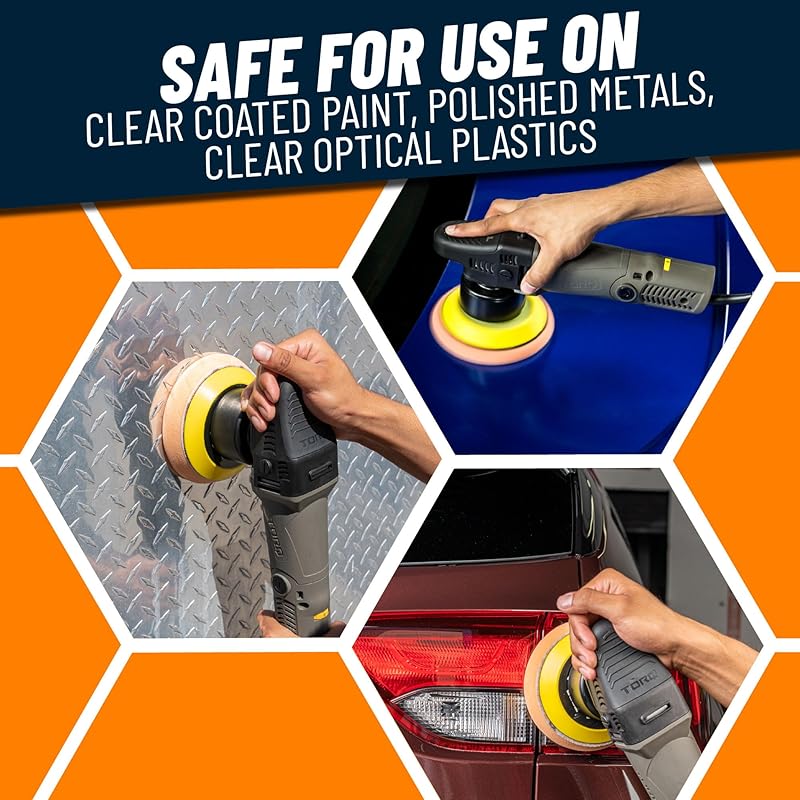
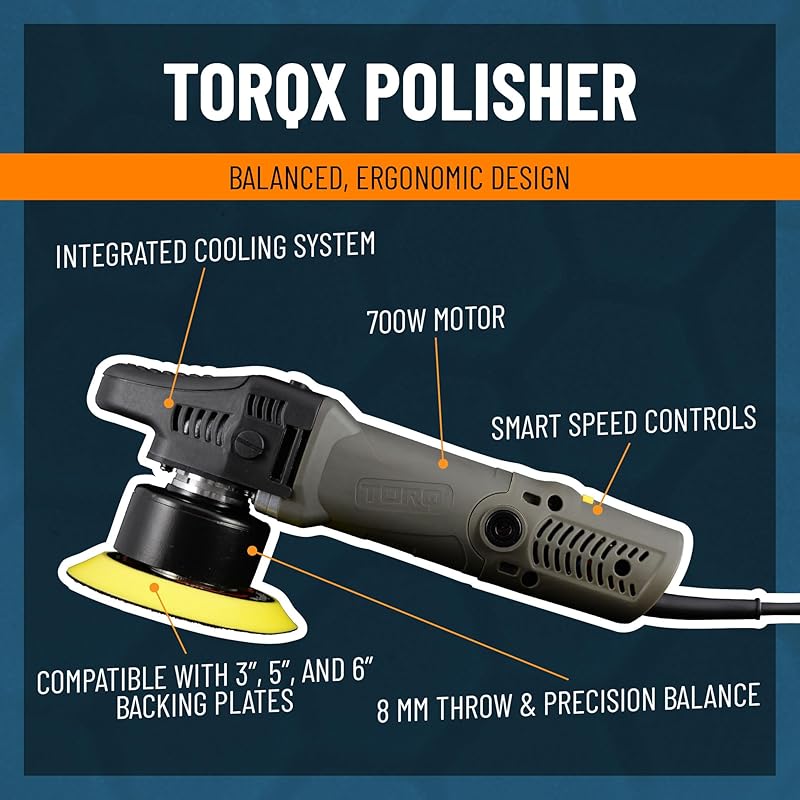
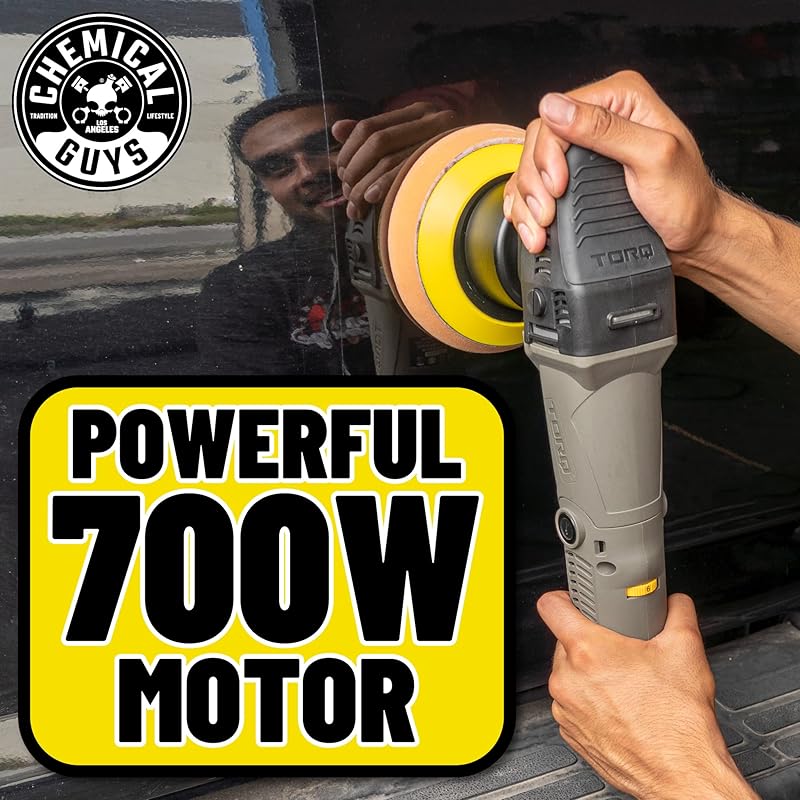
The TORQX 9-piece kit (BUF503X) has 6,414 reviews at 4.6 stars, making it the most user-reviewed complete detailing kit on Amazon. The machine is the same TORQX random orbital polisher as the standalone version, with a 700W motor and 8mm orbital throw.
What justifies the $219.99 price over the standalone machine is everything else in the box. You get cutting, polishing, and finishing pads, compounds and polishes for each stage, and enough material to complete a full detail on a sedan immediately after opening the box.
The car paint buffer experience this kit delivers is genuinely complete. Most beginners who buy just a machine then spend another $80-100 assembling the consumables. The kit front-loads that cost.
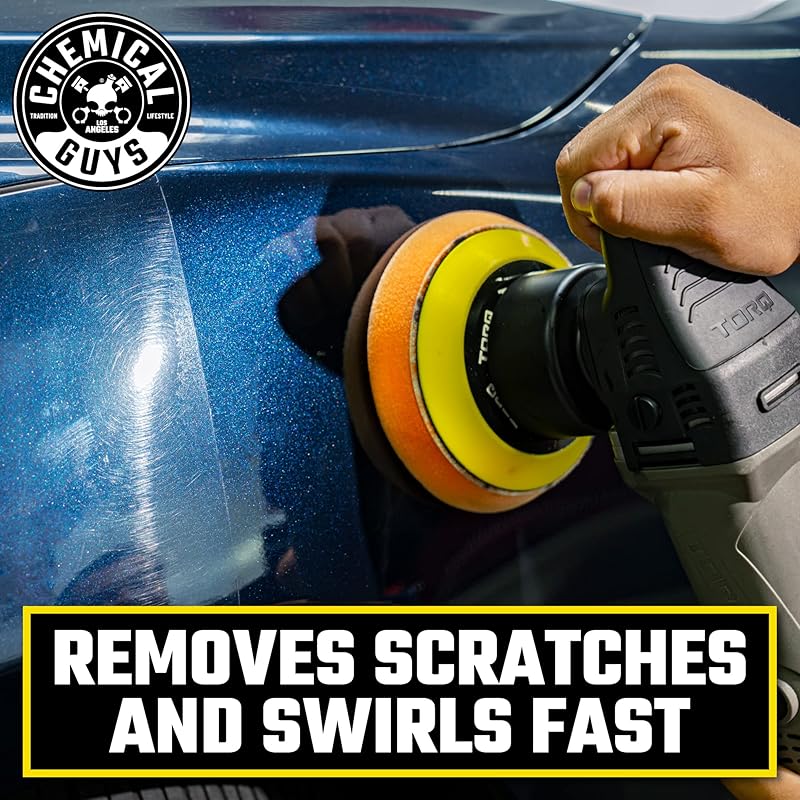
The machine's random orbital action means you won't burn clear coat through beginner mistakes. The 8mm throw is assertive enough to remove light swirls and oxidation. For a first setup that covers everything from paint correction to wax application, this is the most complete single purchase on this list.
Pros: - Complete setup including machine, pads, and compounds - Safe random orbital design for learning detailers - Cost-effective compared to buying components separately
Cons: - 700W motor limits effectiveness on heavy correction work - Included compounds are good but not premium-grade - 9 pieces sounds comprehensive, but you'll want more pads for a full-car session
Chemical Guys TORQX Dual Action Polisher, Solo
The same TORQX machine without the kit accessories.
Standout features: - 700W motor, optimized 8mm orbital throw - Lightweight 4.7 lb design for comfortable extended sessions - Compatible with standard 5-inch backing plates
The standalone TORQX at $154.99 makes sense if you already own pads, compounds, and polishes from previous detailing work. You're paying for the machine alone, which is approximately $65 less than the kit version.
With 4,364 reviews at 4.6 stars, the TORQX has one of the highest trust ratings for a DA polisher at this price. The 700W motor handles typical clearcoated vehicle work well. The 8mm orbital creates the right balance between correction efficiency and safety.
For wax application specifically, the random orbital action creates a more even coverage than hand application. The machine spreads wax in a consistent pattern without pressure inconsistencies or missed areas. Running it at 900-1,200 RPM with a soft finishing pad applies wax perfectly.
Where it falls short is aggressive correction. Single-stage paint with heavy oxidation, or deep sanding marks from bodywork, require more power than 700W provides efficiently. The DEWALT DWP849X will get those jobs done faster.
Pros: - Proven high-review-count machine at accessible price - Random orbital design is forgiving and learner-friendly - Works well for both polishing and wax application stages
Cons: - 700W insufficient for heavy-cut correction on severely oxidized paint - No accessories included at this price - 8mm orbit requires attention on thin factory paint
PORTER-CABLE 7424XP, 6-Inch Orbital Variable Speed
The reliable mid-priced DA polisher with a proven track record since its release.
Standout features: - 4.5 amp motor with electronic variable speed 2,500-6,800 OPM - Random orbit, swirl-free action with 5-inch counter-balance - Classic design that's been refined over multiple production runs
The PORTER-CABLE 7424XP has 2,892 reviews at 4.6 stars. It's been on the market for years and remains one of the top-selling orbital polishers because it genuinely works without complications. At $159, it falls between the budget machines and the premium DEWALT.
The 6-inch backing plate with 5-inch counter-balance produces a smooth, swirl-free action at all speed settings. The electronic variable speed dial runs from 2,500 to 6,800 OPM, which is a wider range than the TORQX. The higher top speed is useful for lighter polish application where you want faster coverage without more pressure.
For car detailing buffer use that spans polishing and wax application across multiple sessions, the PORTER-CABLE is a dependable machine that shows up and works every time. No frills, no complications.
The 4.5 amp motor is on the lighter side compared to the TORQX's 700W (roughly 5-6 amps). For most home use, this difference doesn't matter. For heavy correction work on older, oxidized paint, you'll feel the power ceiling sooner.
Pros: - Long market history with large review base for reliability assessment - Variable speed range broader than many competitors - Simple, proven design with no unnecessary complexity
Cons: - 4.5 amp motor underwhelms on heavy correction work - Fixed 6-inch platform limits pad size flexibility compared to 5-inch machines - Older design lacks some ergonomic refinements of newer machines
Seesii Car Buffer Polisher 1600W, 7"/6" Rotary
The budget rotary that delivers serious wattage for under $50.
Standout features: - 1600W pure copper motor, 7 speeds from 2,056 to 3,600 RPM - Speed lock button for hands-free continuous operation - Dual handle options (D-handle and side handle)
The Seesii at $49.99 is the budget answer to the DEWALT DWP849X. It won't match the DEWALT's build longevity or precision, but 1600W of copper motor power at this price is genuinely difficult to argue with.
With 18 reviews at 4.7 stars, sample size is the legitimate concern. What's there is positive. The manufacturer does disclose the 10-minute cool-down requirement, which is appropriate transparency for a budget motor.
The speed lock button is a practical feature. During large panel work, holding the trigger for extended periods causes hand fatigue. Lock the speed, let the machine run, and guide with both hands without squeezing. This is a feature even some expensive machines don't include.
For wax application, the Seesii drops to low speeds (1,000-1,800 RPM equivalent range) and applies product evenly. For correction work, the higher range handles compound passes effectively. The key: this is a rotary machine. Learn the technique before you start on your main vehicle.
Pros: - 1600W power at a fraction of premium machine pricing - Speed lock is genuinely useful for large panel work - Copper motor construction improves heat management
Cons: - Limited review history makes long-term reliability unclear - Rotary design requires skill; beginners should start with a DA - 10-minute cool-down limits back-to-back heavy sessions
Dobetter Constant Car Buffer Polisher 1500W with LCD Display
The machine with the most informative display for learning correct speed discipline.
Standout features: - Real-time LCD display shows exact RPM with ±1% accuracy - Constant-speed motor maintains set RPM under load - 6-speed range from 1,000 to 3,500 RPM with 13-foot cord
The Dobetter stands out because it tells you exactly what it's doing. The LCD display shows your RPM in real time, which eliminates guesswork during polishing and wax stages. When you're learning, knowing you're at 1,200 RPM for wax vs. 2,200 RPM for polish makes a genuine difference in results.
The constant-speed technology is the other significant feature. Budget motors slow down when you apply pressure during compound passes. The Dobetter maintains its set RPM within ±15 RPM even under load. This means your speed settings actually represent what the machine is doing, which is important for reproducible results.
At $43.99 with 17 reviews at 4.7 stars, the limited review count is a concern for buyers who prioritize established reliability. The specifications are legitimate, and the features are genuinely useful. The question is longevity under sustained professional-level use.
The 13-foot cord covers 360 degrees around a full-size car without moving the power outlet. That's a practical detail that most cord-length specs don't match.
Pros: - LCD display provides exact RPM feedback for precise speed control - Constant-speed motor maintains output under varying load conditions - 13-foot cord length is genuinely practical for full-car work
Cons: - Very limited reviews for assessing long-term reliability - Rotary machine, not appropriate for beginners - LCD display adds cost that buyers just wanting a simple machine won't use
Milwaukee Cordless Polisher (M18 Platform, Tool Only)
Cordless freedom for Milwaukee tool system owners.
Standout features: - Compatible with Milwaukee M18 battery platform - 4.7 stars from 827 reviews - Designed for automotive buffing and waxing tasks
Milwaukee's cordless polisher at $169 is the right choice for one specific buyer: someone already invested in the M18 battery platform who wants to add polishing capability without buying into a new tool ecosystem.
The M18 platform has excellent battery options, including high-capacity 5Ah and 8Ah packs that provide solid runtime for automotive work. Milwaukee doesn't publish detailed OPM specs for this model, which is mildly frustrating for technical comparison. The 827 reviews at 4.7 stars indicate consistent user satisfaction, primarily for waxing and light polishing tasks rather than aggressive correction.
For wax application, light polish maintenance, and regular car wax buffer work, the Milwaukee performs well. For deep paint correction on oxidized vehicles, the undisclosed power specs are a concern. I'd lean toward the DEWALT DCM848B if cordless performance is the priority, especially for correction work.
The freedom of no cord is real and worth something. No extension cord management, no cord drag across fresh wax, no hunting for an outdoor outlet.
Pros: - Integrates seamlessly into the M18 tool ecosystem - Solid review count for confidence in waxing and light polish work - Genuine cordless convenience for garage and driveway use
Cons: - Limited published specs make technical comparison difficult - Tool-only pricing requires factoring in battery cost if not already owned - Less ideal for heavy correction work than corded alternatives
Fanttik P10 Pro Mini Car Buffer Polisher
The compact specialist for tight areas that full-size machines can't reach.
Standout features: - 0.58 lbs weight for comfortable use on mirrors and badges - 4000mAh battery with 50-minute runtime and Type-C charging - 2/3-inch pad sizes for precision work in confined spaces
The Fanttik P10 Pro at $69.99 is a purpose-built tool for the finishing work that full-size polishers can't do. Side mirrors, door handles, A-pillars, car badges, and tight body contours around bumper corners are all areas where a 5 or 6-inch pad simply doesn't fit.
With 35 reviews at 4.7 stars, the P10 Pro is a newer product without an extensive review history. The specs are honest and well-suited to the use case. The planetary gear system keeps vibration low at 65 dB maximum, which is important for detail work on small surfaces where pressure control matters.
This is a companion tool rather than a primary machine. Buy it after you have a full-size polisher for panel work. The P10 Pro fills the gaps, quite literally, that your main machine leaves behind.
At 300-950 RPM, it's a finishing speed range. You won't remove serious defects with this machine. But you can apply wax to a mirror cap, polish a door handle, and finish the trim around a rear badge in ways that would be awkward or impossible with a full-size machine.
Pros: - Fills a genuine gap for precision work in tight areas - Extremely lightweight at 0.58 lbs, comfortable for detailed work - Cordless with adequate battery life for supplemental use
Cons: - Speed range tops out at 950 RPM, limiting correction capability - Too small for main panel work - Limited review history for reliability confidence
PORTER-CABLE 7424XP (Second Review Context)
The dependable workhorse for buyers who want proven, uncomplicated performance.
The PORTER-CABLE 7424XP also serves well as a detailing buffer for wax-only use. Its gentle counter-balance system at lower OPM settings applies wax consistently without the marring risk that higher-speed machines create on freshly polished paint.
For someone who wants a separate wax application machine from their correction polisher, the 7424XP at $159 is a logical choice. Use your correction machine for compounds and polish, and the Porter-Cable for the wax stage at 2,500-3,500 OPM with a soft foam or microfiber finishing pad.
Buying Guide: What Matters for a Buffer Waxer
Dual-Use Capability
The best buffer waxers handle both polishing and wax application stages without requiring a separate machine. Look for a machine with a broad enough speed range (at least 1,000-6,000 RPM or OPM) to cover both stages and a spindle mount that accepts standard 5-inch or 6-inch pads of different grades.
Orbital vs. Rotary for Wax Application
Both work for wax. Random orbital polishers are safer and produce more even distribution due to the oscillating motion. Rotary machines apply wax faster if you know the technique. For beginners applying wax only, a DA is the right choice. For experienced detailers doing a full correction-to-wax cycle, either works.
Speed Control Granularity
Wax application sits at the bottom of the speed range, typically 900-1,500 RPM or OPM. A machine with only 3 speed settings may not give you precise enough control at low speeds for even wax application. Look for at least 6 speed settings or a variable dial with fine control at the low end.
Weight and Balance
Wax application sessions are long. You're doing multiple slow passes over every panel. A heavy machine creates arm fatigue that leads to inconsistent application. Machines under 5 lbs, like the Chemical Guys TORQX at 4.7 lbs, are noticeably more comfortable for wax sessions than heavier rotary machines.
Pad Compatibility
For wax, you want a soft foam or microfiber finishing pad. Confirm the machine uses a standard 3/8-inch spindle thread and accepts the 5.5-inch or 6.5-inch pads appropriate for your backing plate size. Proprietary connections limit your options significantly.
FAQ
Can I use a polisher to apply wax? Yes, and it's actually better than hand application for even coverage. Use a soft foam finishing pad, set the machine to low speed (1,000-1,500 RPM), apply a small amount of wax to the pad, and spread it over each panel in overlapping passes. The machine distributes wax more consistently than hands.
Do I need to polish before waxing? Not always. If your paint is in good condition with no significant swirls or scratches, you can apply wax directly after washing and clay bar treatment. If there are visible defects, polish first to remove them before protecting with wax.
How much wax should I put on the pad? Less than you think. A dime-to-quarter sized amount per pad is enough for a medium panel. Adding more doesn't improve protection and creates more work during removal. Start light and add more if needed.
What pad do I use for wax application? A soft foam finishing pad (white or light blue typically) or a microfiber application pad. Do not use a cutting or polishing pad for wax. The firmer grades will remove product from the pad before it transfers to the paint.
Should I use machine wax or hand wax? Most spray waxes and liquid waxes work well for machine application. Paste waxes can be applied by machine with a soft pad at low speed. Avoid products with heavy solvents or harsh abrasives if you're applying them with a machine, as the heat generated can cause unpredictable results.
How long should I let the wax cure before buffing? Most liquid and spray waxes cure within 60-90 seconds in moderate temperatures. Check for the haziness that indicates the wax has set, then buff off with a clean microfiber towel. In direct sun or high heat, cure time shortens. In cold or shade, it takes longer.
Conclusion
For a complete machine that handles correction, polishing, and wax application: the Chemical Guys TORQX 9-piece kit at $219 is the best single purchase if you're starting from scratch. The standalone TORQX at $155 is better value if you already have accessories. For professional-grade results across all stages: the DEWALT DWP849X at $279 is the standard. For a mid-range proven option: the PORTER-CABLE 7424XP at $159 handles regular maintenance buffing and waxing reliably without requiring correction-level technique.
If cordless is the priority: the Milwaukee M18 polisher at $169 works for M18 platform users. If budget is the constraint: the Seesii 1600W at $50 delivers rotary power at an uncommonly low price, for buyers who already know how to use a rotary machine.