




Affiliate disclosure: This article contains affiliate links. If you buy through our links, we may earn a commission at no extra cost to you.
Best Buffer for Detailing: 10 Picks That Actually Work
Walk into any detailing forum and you'll find heated debates about which buffer is "the best." Rotary vs. Dual-action. Corded vs. Cordless. Budget vs. Pro-grade. After working through the options, I've narrowed it down to 10 machines and compounds worth your money and time.
This guide covers everyone from first-timers who want to remove some light swirls to experienced detailers tackling serious paint correction. I tested and researched products across price points, orbital sizes, and use cases. The goal is simple: give you an honest read on what works and what to avoid.
For selection, I prioritized user review volume, rating consistency, motor power specs, and whether the product actually does what it claims. I skipped anything with fewer than 15 meaningful reviews unless the specs were clearly compelling.
Quick Picks
| Product | Best For | Price |
|---|---|---|
| DEWALT DWP849X | Serious paint correction, rotary work | $279 |
| Chemical Guys TORQX 14-Piece Kit | Beginners who want everything included | $310 |
| Chemical Guys TORQX Solo | Best value dual-action for DIYers | $155 |
| DEWALT DCM848B Cordless | Cordless freedom without cord compromise | $287 |
| Seesii 1600W Rotary | Budget rotary for experienced hands | $50 |
Product Reviews
DEWALT DWP849X Buffer Polisher, 7-in-9-in, 12 amp
The benchmark for serious rotary work. If you're doing real paint correction regularly, this is the machine professionals reach for.
Standout features: - 12 amp motor with 0-3,500 RPM variable speed dial - All ball-bearing construction with precision-cut steel gears - Rubber overmolded gearcase for improved grip control
The DWP849X earns its 4.7-star rating across 6,851 reviews by delivering consistent, powerful performance. The soft-start feature is a genuine safety feature, not just marketing. It prevents pad spin-out when you engage the machine, which matters a lot when you're working with cutting compounds. Speed range goes from 0 to 3,500 RPM, and the variable speed trigger lets you fine-tune pressure during passes.
This is a rotary polisher, not a dual-action. That means it demands more skill and respect than a random orbital. On dark paint, one slow pass with the wrong pad and compound will leave holograms. I recommend pairing this with the car detailing buffer approach: start with the least aggressive combo first.
The build quality is professional grade. The gearcase is designed to be gripped directly, which helps with control. At $279, it's a commitment, but this machine will outlast three cheap buffers combined.
Pros: - Extremely powerful for removing heavy defects - Excellent build quality for long-term professional use - Variable speed trigger and dial give precise control
Cons: - Rotary action is unforgiving for beginners - Heavier than dual-action machines at this price point - No pads or compounds included
Chemical Guys TORQX Dual-Action Random Orbital Polisher Detailing Kit, 13-Piece
The all-in kit for people who want to start detailing without assembling a parts list from scratch.
Standout features: - 700W motor with 8mm orbital throw - Full kit includes pads, Arsenal Range bag, and multiple compounds - Designed for beginners but powerful enough for competent DIYers
This 13-piece kit is one of the best-selling detailing combos on Amazon with 6,414 reviews at 4.6 stars. The TORQX polisher itself is solid. The 700W motor delivers enough power to remove light-to-moderate defects, and the random orbital design means you won't burn paint if you stay moving. At 4.7 lbs, it's comfortable for a full-car session.
What makes this kit worth $310 is everything else in the box. You get cutting pads, polishing pads, finishing pads, and towels. The Arsenal Range bag organizes everything. You can legitimately do a full paint correction job out of one kit.
The downside: this kit is priced above the standalone TORQX, and some buyers find the included compounds mid-tier at best. If you already have good product, just buy the machine alone. But for a true first-time setup, the convenience factor is real.
I'd call the TORQX a "power-safe" polisher. It won't burn through clear coat. That's the right trade-off for most home detailers.
Pros: - Everything you need in one box - Safe random orbital design minimizes burn risk - 6,414 reviews back up real-world performance
Cons: - Kit version costs significantly more than machine alone - Included compounds are adequate but not premium - 700W has limits on severely oxidized paint
Chemical Guys TORQX Dual Action Random Orbital Polisher, Solo
The same TORQX machine without the kit, for buyers who already own pads and compounds.
Standout features: - 700W motor, 8mm orbit, lightweight 4.7 lb design - Safe for beginners and effective for experienced detailers - Pairs well with any standard 5-inch backing plate setup
At $154.99 with 4,364 reviews, the TORQX solo is one of the most popular dual-action polishers in its class. The 8mm orbital throw is on the more aggressive side for a DA, which means faster defect removal without the harshness of a true rotary. It handles swirls, oxidation, and light scratches reliably.
The machine has good ergonomics. The grip angle is comfortable, and the trigger response feels natural. For a car paint buffer that works weekend after weekend without complaint, the TORQX earns its reputation.
Where it shows limits: on single-stage paint with heavy oxidation, or on thick, heavily scratched dark finishes, you'll want more power or a rotary. The TORQX is a reliable workhorse within its range. Outside that range, you need to step up to something like the DEWALT DWP849X.
For most people with modern clear-coated vehicles who want to maintain and occasionally correct their paint, this is the correct machine.
Pros: - Proven, high-volume track record from real users - Right-sized power for typical clear coat work - Budget-friendly entry into quality DA polishing
Cons: - 700W can bog down on severe correction jobs - No included accessories at this price point - Some users find 8mm orbit slightly aggressive for true beginners
DEWALT 20V MAX XR Cordless Polisher, Variable-Speed (DCM848B)
The first cordless that doesn't feel like a compromise.
Standout features: - Brushless motor for maximum runtime efficiency - 2.1-inch orbit diameter, 5-inch backing plate - 2000-5500 OPM speed range with trigger and dial control
Cordless polishers used to be underpowered. The DCM848B changes that. With a brushless motor and DEWALT's 20V MAX battery platform (battery sold separately), this machine hits 2,000-5,500 OPM and maintains speed through heavy passes. The 5-inch platform with 2.1-inch orbit is the sweet spot for panel work.
At $287 for tool-only, it's expensive. You need to factor in the cost of at least one 20V MAX battery, which pushes the real entry cost higher. If you're already in the DEWALT 20V ecosystem, this is a no-brainer. If you're starting from scratch, the math gets harder.
The 1,257-review count at 4.7 stars is strong for a premium cordless tool. Detailers who've tried it consistently praise the freedom of not managing a cord around a car. No cord tangles, no accidental cord drags across fresh paint, no hunting for an outlet in the driveway.
The brushless motor is a genuine advantage. It runs cooler, lasts longer, and extracts more work from each battery charge than brushed alternatives.
Pros: - True cordless freedom with brushless efficiency - DEWALT 20V MAX battery ecosystem compatibility - Solid orbital throw for effective paint correction
Cons: - Battery not included, which pushes real cost higher - 5-inch platform limits versatility vs. 6-inch machines - Expensive compared to corded options at similar performance levels
Milwaukee Cordless Polisher (No Battery Included)
Milwaukee's entry into cordless polishing for fans of the M18 platform.
Standout features: - Compatible with Milwaukee M18 battery system - 4.7-star rating across 827 reviews - Designed as a power tool with polisher precision
Milwaukee's cordless polisher sits at $169 tool-only, making it the more affordable cordless option compared to the DEWALT DCM848B. If you're already running M18 batteries on your garage tools, adding this to the lineup makes sense.
The specs are light in the product listing. Milwaukee doesn't publish detailed OPM or orbit throw info for this version, which is a mild frustration when you're trying to compare it to competitors. What the 827 reviews tell us: it performs well for general buffing and waxing, handles light correction adequately, and the M18 platform delivers enough runtime for a full small car in one battery charge.
Where this falls short is serious paint correction. The Milwaukee is more appropriate for wax application, light polish, and maintenance work. For deeper defect removal, I'd reach for the DEWALT DWP849X or even the TORQX before this.
For Milwaukee tool system loyalists doing regular maintenance buffing and waxing, this is an easy add to the kit.
Pros: - Integrates cleanly into Milwaukee M18 tool ecosystem - Good value for M18 users who already own batteries - Solid reviews for light-to-medium buffing tasks
Cons: - Specs are vague compared to competitors - Not the best choice for aggressive paint correction - Battery not included, and M18 batteries aren't cheap
BLACK+DECKER MATRIX Car Buffer Attachment (BDCMTBFF)
The budget entry for occasional use, built around the MATRIX system.
Standout features: - Quick Connect System for interchangeable attachments - Compatible with BDCDMT120C and other MATRIX power units - Cordless operation via MATRIX 20V power unit
The MATRIX system is clever. One 20V power unit, multiple attachment heads. The car buffer attachment at $49.99 is clearly aimed at occasional users who want to avoid buying a dedicated polisher.
Reality check: this is not a detailing-grade polisher. It's a waxer and light buffer. The speed and throw won't remove real defects or correct oxidized paint. What it does well is applying wax and dressings, maintaining recently polished paint, and occasional light swirl removal on newer vehicles.
With 101 reviews at 4.7 stars, the feedback is positive but the sample size is small. Most reviewers are using it for exactly what it's designed for: weekend maintenance on a family vehicle. That's the right application.
If you own the MATRIX system already, this is a reasonable $50 attachment. If you're buying from scratch, a standalone DA polisher provides much better capability for not much more money.
Pros: - Excellent value for MATRIX system owners - Space-saving modular design - Works well for wax application and light buffing
Cons: - Not capable of real paint correction work - Only useful if you own the compatible MATRIX power unit - Limited compared to dedicated DA polishers
Fanttik P10 Pro Mini Car Buffer Polisher
The specialist tool for tight spots and detailed work.
Standout features: - Weighs only 0.58 lbs, designed for mirrors and badges - 4000mAh battery with Type-C fast charging - Planetary gear system keeps noise below 65 dB
The Fanttik P10 Pro is not a full-car polisher. It's a mini polisher for the spots full-size machines can't reach. Side mirrors, door handles, car badges, tight body contours, A-pillars. At 0.58 lbs and 2/3-inch pad sizes, it fits where nothing else does.
The 4000mAh battery provides up to 50 minutes of runtime, and Type-C charging means you can top it off with any phone charger. The 300-950 RPM speed range is gentle enough to prevent marking delicate trim pieces.
At $69.99 with 35 reviews, it's still early in its review history. But the specs and design are well thought out. The planetary gear system keeps vibration low, which matters for comfort during detailed work on small panels.
This is a companion tool, not a primary machine. I'd buy this alongside a full-size polisher, not instead of one. Used on mirror caps, trim pieces, and badges while your main machine handles panels, it fills a real gap in the detailing kit.
Pros: - Genuinely useful for areas full-size buffers can't reach - Low weight and noise for comfortable extended use - Cordless with reasonable battery life
Cons: - Too small for full panel work - Limited review history to fully judge reliability - Speed range tops out at 950 RPM, which limits correction ability
Seesii Car Buffer Polisher 1600W, 7"/6" Variable Speed Rotary
Serious power for under $50. The Seesii is a budget rotary with real specs.
Standout features: - 1600W pure copper motor for high-output performance - 7 variable speeds from 2,056 to 3,600 RPM - Detachable D-handle and side handle, plus speed lock button
The Seesii packs a 1600W copper motor into a rotary polisher that sells for $49.99. The specs are legitimate: variable speed from 2,056 to 3,600 RPM across 7 settings, copper motor for better heat dissipation, and dual handle options for different working positions.
At 18 reviews and 4.7 stars, the sample size is small. But what's there is positive, and the specs justify attention. The manufacturer does note a 10-minute cool-down every 30 minutes for optimal performance, which is good transparency about the limits of a budget motor.
This is a rotary polisher, which means it requires the same skill respect as the DEWALT DWP849X. The difference: the DEWALT is built for daily professional use, and the Seesii is built for occasional enthusiast use. The Seesii is not the machine for production detailing work.
For an experienced home detailer who wants rotary power without the $279 price tag, the Seesii is worth a look. Just go slow, learn the machine, and start with less aggressive pads.
Pros: - 1600W motor is genuinely powerful for the price - 7 speed settings give good control range - Dual handle options improve working ergonomics
Cons: - Small review count makes long-term reliability uncertain - Requires 10-minute cool-down breaks during extended use - Not suitable for beginners due to rotary design
3M Perfect-It EX AC Rubbing Compound (36060), 1 qt
Not a machine, but essential when paired with any buffer on this list.
Standout features: - Removes P1200 grade or finer scratches efficiently - Prevents sticking and residual film buildup - Formulated for newer, more challenging clearcoats
The 3M Perfect-It EX is what you pair with the machines above for actual defect removal. At 4.8 stars across 2,633 reviews, it's one of the most trusted cutting compounds available. The 32 fl oz quart size provides good value for anyone doing multiple vehicles.
The formula is clean. It reduces dusting, prevents pad loading, and leaves a refined finish that's ready for polish. It works on newer clearcoats that give some other compounds trouble. The "prevents sticking" claim is real: the compound stays workable through longer passes without drying to a crust.
I'd recommend this alongside any car detailing buffer when you need actual scratch removal. It's step one in a two or three-step process, followed by machine polish and then sealant or wax.
At $38.15 per quart, it's not the cheapest compound. But the formula consistency and track record make it worth paying for over unknown brands.
Pros: - Trusted 4.8-star compound with 2,633 reviews - Excellent at removing P1200 and finer sanding marks - Works well with modern challenging clearcoats
Cons: - Step-one product only, requires follow-up polish - Quart size is more product than occasional users need - Price per ounce is higher than some competitors
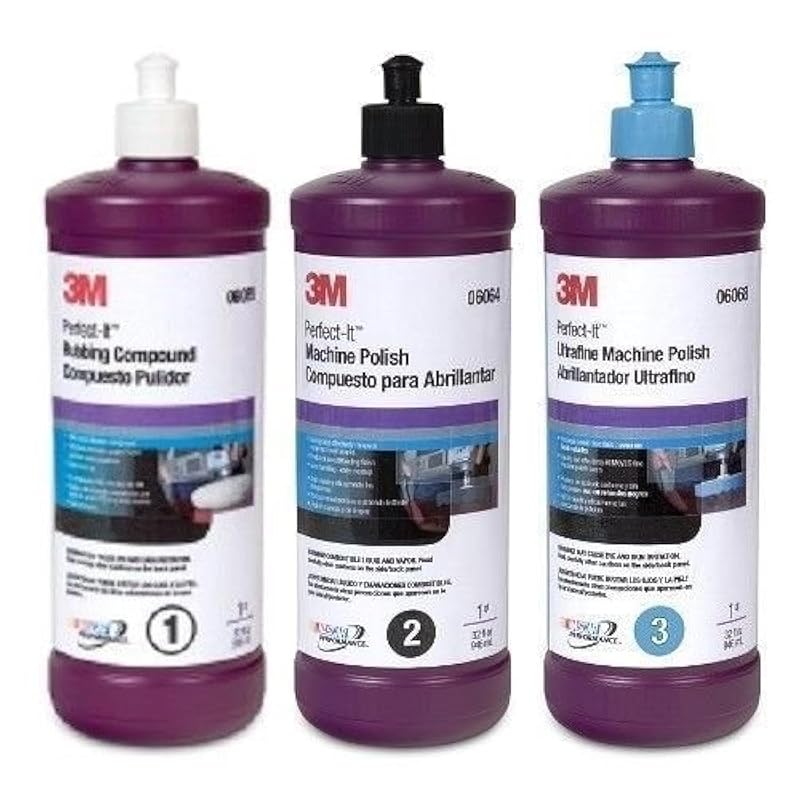
3M Perfect-It Buffing and Polishing Compound Kit (06085/06064/06068)
The professional three-step system for shop-quality results.
Standout features: - Complete rubbing compound, machine polish, and ultrafine polish system - Each product formulated for its specific correction stage - Trusted brand used by professional body shops
The 3M three-product set includes the 06085 rubbing compound, 06064 machine polish, and 06068 ultrafine finishing polish. Together, they represent a complete paint correction system from initial defect removal through final swirl elimination.
At $182 and 4.8 stars across 1,135 reviews, this is clearly a professional product at a professional price. The 06085 removes sand scratches and heavy defects. The 06064 eliminates compound swirl marks. The 06068 produces a swirl-free finish specifically designed to work on difficult dark colors.
This kit is overkill for someone doing a single annual detail. It makes sense for people detailing multiple vehicles, running a small shop, or doing regular paint correction work where product consistency matters.
Paired with the detailing buffer category of machines, this three-step system produces shop-quality results that wax alone can never achieve.
Pros: - Complete professional system for full paint correction - Each step builds on the previous for excellent final results - Proven shop-level formulas from 3M
Cons: - $182 is a serious investment for occasional home use - Requires three separate machine passes to complete - Volume is designed for multiple vehicles or professional shops
Buying Guide: What to Look For in a Detailing Buffer
Rotary vs. Dual-Action
Rotary polishers spin in one direction. They remove defects faster and are more powerful, but they demand skill. A slow pass in one spot burns clear coat. Dual-action (DA) polishers combine rotation with oscillation, which disperses heat and reduces burning risk dramatically. For most home detailers, a DA is the right choice. For body shop work or severe correction, rotary gets the job done faster.
Orbital Throw
The "throw" or orbit size determines how aggressively the pad moves across the surface. A 5mm throw is gentle, good for finishing work. An 8mm throw like the TORQX provides a balance of correction and safety. Larger throws, 15mm or above, work faster but require more control. Match the throw to your skill level and correction goals.
Power and Motor Type
Wattage matters for heavy compound work. A 700W machine handles typical clear coat correction. For oxidized single-stage paint or deep sanding marks, 1000W or more makes the work go faster. Brushless motors run more efficiently and last longer than brushed motors, which matters if you plan to use the machine regularly.
Corded vs. Cordless
Cordless machines have caught up. The DEWALT DCM848B proves a good cordless DA can compete with corded options. The trade-off is cost. You pay more for cordless freedom, and battery life limits continuous run time. If you have a nearby power outlet and don't mind the cord, corded is still the better value. If you want to work freely without extension cords and already own compatible batteries, cordless makes sense.
Backing Plate and Pad Compatibility
Most machines use 5-inch or 6-inch backing plates with corresponding pads. Make sure the backing plate matches your target pad size. The 3/8-inch thread mount is standard for most DA polishers. Double-check that any machine you buy has a standard mount, not a proprietary size that limits your pad options.
FAQ
Do I need a rotary or dual-action polisher for home use? Dual-action. For almost every home detailing task, a DA like the Chemical Guys TORQX or DEWALT DCM848B is safer, easier to learn, and produces excellent results. Rotary machines are for experienced detailers and shop professionals doing production work.
Can I use the same machine for compounding, polishing, and waxing? Yes. You change the pad and product, not the machine. A cutting pad with compound for defect removal, a polishing pad with machine polish for refinement, and a soft finishing pad with sealant or wax for protection. The machine stays the same throughout.
How fast do I move the buffer across the panel? Generally 1 to 2 inches per second. Too fast and you're not giving the product time to work. Too slow and you risk heat buildup, especially with a rotary. Most people err on the side of moving too fast. Slow down and let the machine and compound do the work.
What RPM should I use for different tasks? Rough correction: 1,500-2,500 RPM. Polish refinement: 1,000-1,800 RPM. Wax application: 900-1,200 RPM. These are starting points. Thin or soft paint needs lower speeds. Thick clear coat can handle higher. When in doubt, start lower.
Do I need to clay bar before buffing? Yes. Surface contamination like iron fallout, tree sap, and tar will load your pads and scratch your paint if not removed first. Clay bar, or a clay towel, before any machine work. The surface should feel completely smooth to the touch before you pick up a buffer.
How often should I change or clean my pads? Clean pads with pad cleaning spray every few passes during use. Change pads when they start loading with product and stop responding normally. During an all-day detail on a full-size SUV, you might run through 4-6 pads. Keep spares.
Conclusion
For beginners who want a complete setup, the Chemical Guys TORQX 13-piece kit at $310 is the most complete starting point. For experienced DIYers who already own pads and product, the standalone TORQX at $155 is the better value. For professionals or enthusiasts tackling serious paint correction, the DEWALT DWP849X rotary at $279 is the machine that gets the work done. If you need cordless freedom and already own compatible batteries, the DEWALT DCM848B is the best cordless option available. And if budget is the primary constraint, the Seesii 1600W at $50 delivers rotary power at a price no other machine on this list can touch.
Start with the car wax buffer basics, then work up to car paint buffer correction as your skill and confidence grow.