









Disclosure: This article contains affiliate links. If you buy through our links, we may earn a commission at no extra cost to you.
One-step paint correction sounds like a dream. One product, one pad, one pass, and your paint looks like glass. The reality is more nuanced, but the right product really can eliminate the compound-then-polish two-step routine for many situations.
I put together this guide for enthusiasts and weekend detailers who want to restore clarity to their paint without investing in a full multi-stage correction setup. Whether you're dealing with light swirls on a daily driver or trying to knock down moderate oxidation on a weekend car, there's a one-step product on this list that fits your needs and budget. If you're ready to go deeper on the process side, check out our guide to detailing your car for a broader overview.
My selection criteria: correction ability, ease of use, finish quality (no holograms, no filler tricks), and whether the results last. I prioritized products that work with both rotary and dual-action polishers since most people have DA machines at home.
Quick Picks
| Product | Best For | Price |
|---|---|---|
| SONAX Perfect Finish | Best overall one-step | $24.99 |
| CSI Ceram-X | Professional shop use | $139.00 |
| 3M Perfect-It EX AC Rubbing Compound | Serious paint correction | $38.15 |
| Griot's Garage BOSS Correcting Cream | DA polisher users | $24.99 |
| KOCHCHEMIE Fine Cut | Value for money | $26.99 |
Product Reviews
SONAX Perfect Finish 250ml
SONAX Perfect Finish is my top recommendation for most people looking for a true one-step solution.
Standout features: - Diminishing abrasive technology removes up to P2000 scratches - Filler-free formula means no shrink-back or hidden defects - Silicone-free, leaves a genuine OEM high-gloss finish
This 8.45 oz bottle punches way above its weight class. The diminishing abrasive technology is what makes it a genuine one-step: it cuts aggressively enough to remove sanding marks and water spots, then breaks down into a finer grit during polishing so it finishes out without holograms. I've used this on black paint, which is the hardest surface to get right, and it came out clean with a DA polisher on a foam pad.
The "no wet sanding required before use" claim is real. If you have P1500 to P2000 sand scratches or standard swirling from wash marring, this handles it in one pass. What it won't do is remove deep gouges or heavy compound scratches, so don't confuse one-step correction with skipping prep entirely.
The 250ml bottle is smaller than competitors at the same price point, which is the main complaint. For a full-size sedan, you'll want two bottles on hand if you're doing a full correction job rather than a spot treatment.
Pros: - Genuine filler-free correction - Works on all clear coats including soft and hard paints - Hologram-free results with a rotary when used correctly
Cons: - 250ml doesn't go far on large vehicles - Requires clean pad and proper technique to get the cut advertised
CSI Ceram-X Car Polish (1 Gallon)
CSI Ceram-X is the professional-grade choice, designed for body shops and serious detailers who need consistent, repeatable results on challenging paint.
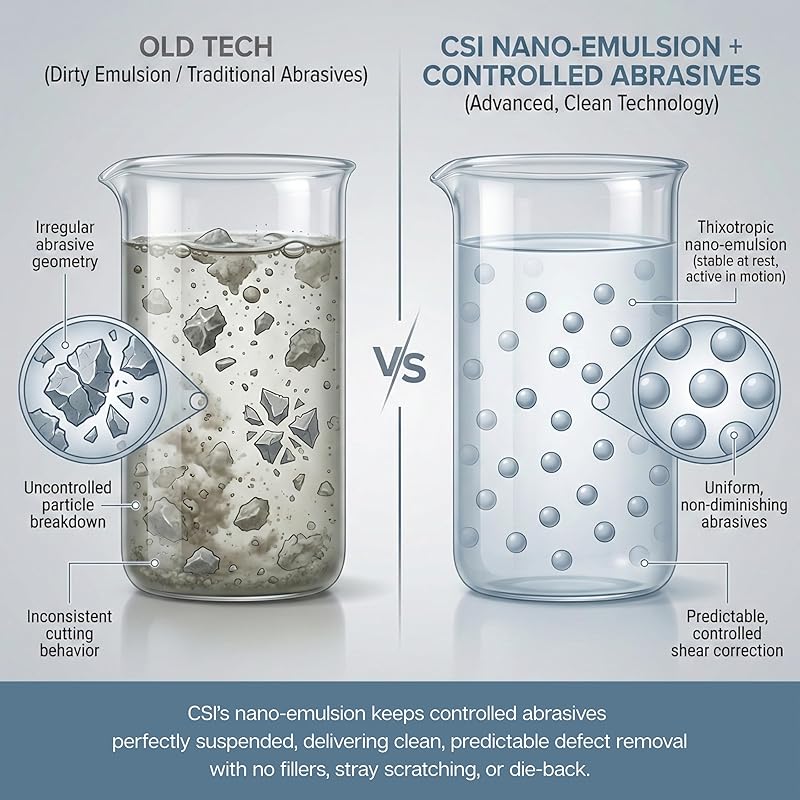
Standout features: - Engineered nano-emulsion system controls abrasive behavior based on mechanical stress - True waterborne thermal stability absorbs friction heat without flashing - Zero fillers, zero solvents, zero waxes, what you see is true correction
At $139 for a gallon, this is not a casual purchase. But if you're running a detailing business or doing multiple cars per week, it makes sense. The nano-emulsion chemistry is genuinely different from most compounds. The abrasive only activates under mechanical pressure, meaning it stays stable until you put the polisher to the panel. Once you're working, it cuts. Stop working, and it stops cutting.
The filler-free claim is important to verify here, and CSI backs it up. There's no shrink-back, no defects that reappear after 24 hours in sunlight. What you correct stays corrected. The waterborne formula also means you're not dealing with solvent fumes in an enclosed shop.
For weekend garage users, the gallon size is overkill. This one belongs in professional hands or in the hands of enthusiasts who detail cars for friends regularly. The learning curve is lower than you'd expect given its professional positioning, but you still need proper machine technique.
Pros: - Professional-grade, repeatable correction - No fillers or solvents, honest results - Non-diminishing abrasives maintain consistent cut throughout use
Cons: - $139 is serious money for a consumer - Gallon size impractical for occasional use - Requires machine polisher, not suitable for hand application
3M Perfect-It EX AC Rubbing Compound (36060, 32 fl oz)
3M's Perfect-It EX AC is the workhorse compound that professional detail shops have relied on for decades, particularly effective on newer, harder clear coats.
Standout features: - Formulated specifically for P1200 grade or finer scratches - Prevents sticking and residual film buildup during use - Reduces dusting significantly compared to older compound formulas
With 2,633 reviews averaging 4.8 stars, this has the track record to back up its reputation. At $38.15 for 32 oz, you're getting solid value compared to boutique brands charging similar money for a fraction of the volume.
The anti-stick formula is something you appreciate only after using compounds that leave residue caked around trim pieces and in panel gaps. 3M's formulation wipes clean, which saves real time during the buffing process. The reduced dusting is similarly practical, especially if you're working indoors where compound dust settles on everything.
This is a cutting compound, not a one-step polish in the traditional sense. It handles the correction but will leave light haze that you'll ideally follow with a finishing polish. However, on soft single-stage paint or older clear coats, a fast-speed pass with a finishing pad can often clean it up to a solid one-step result. On newer hard clear coats, budget for a second step.
Pros: - Excellent track record with thousands of verified reviews - Low dusting formula keeps work area cleaner - Works well on challenging modern clear coats
Cons: - Leaves haze on hard clear coats that may need a finishing step - 32 oz is generous but the price reflects professional quality - Best results require machine use, hand application is tedious
Griot's Garage BOSS Correcting Cream (16oz)
Griot's Garage BOSS Correcting Cream focuses on moderate defects and is specifically engineered to work beautifully with their BOSS pad system.
Standout features: - Extended buff cycle that won't dry out or create dust - Designed for moderate defects: light scratches and swirl marks - High-lubricity formula prevents dry buffing and heat buildup
At $24.99 for 16 oz, this sits at a very reasonable price point for what it delivers. The extended buff cycle is the feature I appreciate most. Many compounds have a narrow working window, dry out fast, and punish you if you're working at a slower pace or on a warm panel. The BOSS Correcting Cream stays workable longer, which translates to better results and fewer micro-marring issues from buffing a dry compound.
It's worth noting upfront that this is rated for moderate defects. It handles swirl marks and light scratches confidently. Deep scratches from keys or road debris are beyond its design intent. If you're dealing with heavy oxidation or compound scratches from a previous bad correction attempt, you'll need something with more cut first.
The pairing with the BOSS Fast Correcting Foam Pad is genuine, not just marketing. The combination works better than the cream alone on a generic pad. That said, it works fine on standard foam cutting pads from other brands too.
Pros: - Extended working time reduces risk of dry buffing - Easy wipe-off with minimal residue - Good value at $24.99
Cons: - Not designed for heavy defects or deep oxidation - Performs best with Griot's own BOSS pads - Limited availability compared to 3M or Meguiar's products
KOCHCHEMIE Fine Cut Polishing Compound (250ml)
KOCHCHEMIE Fine Cut is a German-engineered silicone-oil-free compound that removes medium to heavy defects while delivering exceptional surface clarity.
Standout features: - Intelligent grain size removes 2500 grade sanding marks effortlessly - Silicone-oil-free formula provides genuine correction without fillers - Unique oxide quality for deep sheen and long-lasting results
German detailing products have earned a strong reputation, and KOCHCHEMIE is one of the best in that market. At $26.99 for 250ml it's pricier per ounce than American brands, but the quality of correction justifies the cost for serious detailers.
The silicone-oil-free specification matters. Silicone oils are commonly added to polishes to make finishes look better than they are. They fill defects temporarily, causing that frustrating die-back effect when you re-examine your work in direct sunlight 24 hours later. KOCHCHEMIE doesn't play that game.
The 250ml volume limits you to about one medium-sized vehicle per bottle when doing a full correction. That's a real drawback for the price. But if you're spot-treating or correcting a single panel at a time, it's more than adequate. The finish quality after use is genuinely exceptional, particularly on darker paint where any remaining haze would be obvious.
Wash marring from automatic car washes, which is the source of most swirl patterns on daily drivers, is eliminated cleanly by this compound. That's its real sweet spot.
Pros: - Exceptional finish quality, particularly on dark paint - No silicone oils, genuine filler-free correction - Removes 2500-grade sanding marks
Cons: - 250ml doesn't go far on full vehicle corrections - Higher price per ounce than comparable American brands - Needs to be sourced from specialty retailers
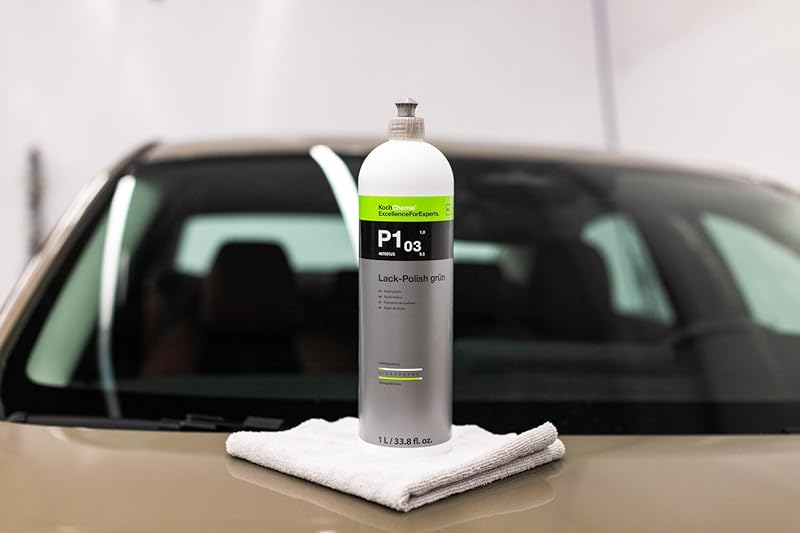
Koch-Chemie Lack Polish Grun P1.03 (1 Liter)
Koch-Chemie's Lack Polish Grun P1.03 is a finishing polish designed for refining new and like-new paintwork, adding depth and gloss rather than heavy correction.
Standout features: - Adds depth and amplifies color on new or near-new paintwork - Compatible with both manual application and orbital polishers - High-gloss finish suitable as a final step before ceramic coating
At $31.99 for a full liter, this is excellent value compared to the 250ml KOCHCHEMIE Fine Cut above. The P1.03 formulation is a polish rather than a compound, meaning lighter correction. If your paint is already in reasonable shape and you want to refine and enhance before applying a sealant or ceramic coating, this is the right tool.
The 4.8-star rating with 17 reviews is a newer product with a small but enthusiastic user base. The German origin and KOCHCHEMIE brand pedigree carry weight in the detailing community.
This isn't the right product if you're dealing with wash swirls or oxidation. It's for refining work: removing the haze left by a cutting compound, or enhancing paint that's already in decent condition. Using a fine-cut pad with an orbital or a finishing pad for the last refining pass gives you that mirror-like result.
Pros: - Full liter is excellent value - Perfect pre-coating surface prep - Works by hand or machine
Cons: - Limited correction ability, not for swirl removal - Only 17 reviews, less track record than competitors - Requires a dedicated cutting step if paint has significant defects
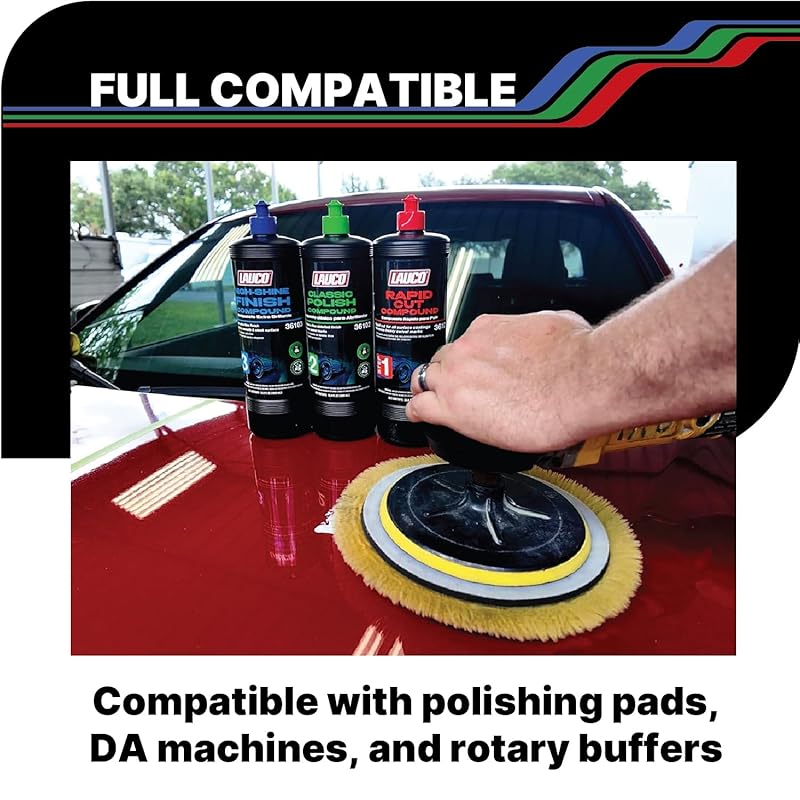
LAUCO Paint Correction Compounds Step 1, 2, 3 (8oz Kit)
LAUCO's 8oz kit provides a complete three-step correction system in one purchase, with a swirl remover and towel included.
Standout features: - Complete three-step system: Heavy Cut, Fine Polish, and High Shine Finish - Silicone-free, clear coat safe formulation throughout - Includes Swirl+Plus Scratch Remover and applicator towel
The appeal of this kit is completeness. You get Step 1 Heavy Cut Compound for deep scratches and oxidation, Step 2 Fine Polish for refining, Step 3 High Shine Finish for final gloss, plus a dedicated swirl remover. At $29.99, you're getting a full correction system for less than most single professional polishes.
The 8oz sizes are small. This is a starter kit or a touch-up kit, not a solution for doing full corrections on multiple vehicles. Each bottle will handle spot treatments and small panel corrections, but don't expect to do a full car correction with these quantities.
The brand is newer with only 1 review, which is the honest caveat here. The formulation claims are solid, and the ingredients profile (silicone-free, no fillers) reads like a reputable product. But the track record of thousands of reviews that 3M or Meguiar's carry isn't there yet. Buy this as a complete entry-level system, not as a replacement for proven professional products.
Pros: - Complete three-step system at an affordable price - Swirl remover and towel included - Clear coat safe formulation
Cons: - Very small review count, limited real-world track record - 8oz sizes are too small for full vehicle corrections - Three separate steps undermines the "one-step" concept
Clean. Foam Polishing Pad 5-inch Blue (1 Pack)
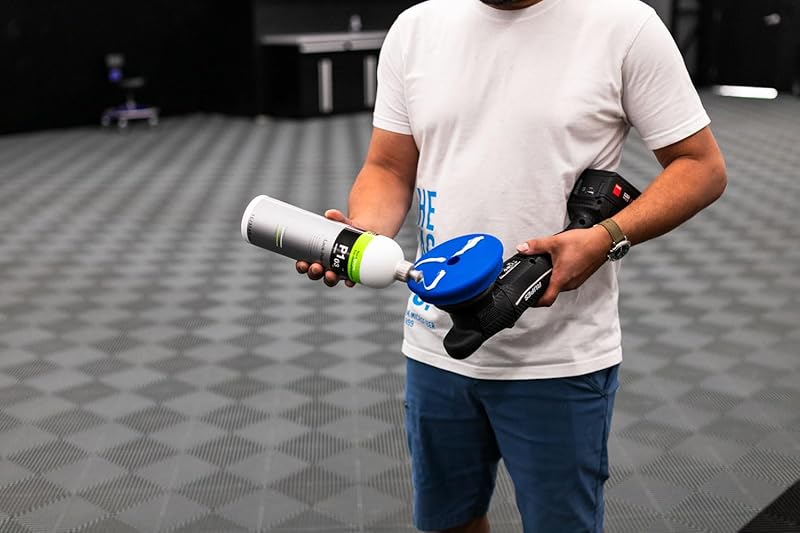
The Clean. 5-inch Blue Polishing Pad is engineered specifically for one-step paint correction, working with rotary, dual-action, and forced rotation machines.
Standout features: - Open-cell foam structure delivers both cut and gloss in a single pad - Heat-resistant adhesive and premium nylon hook-and-loop backing - Balanced and lightweight design reduces fatigue during extended sessions
A pad is only as good as its pairing with the right compound. The 5-inch size is the sweet spot for most dual-action polishers, compatible with the 5-inch backing plate on machines like the Rupes, Flex, and most budget DA polishers.
The open-cell foam that characterizes a "polishing" pad grade provides medium correction with a finer finish than a cutting pad. It won't bulldoze through heavy defects, but for removing light swirls, water spots, and moderate oxidation in one pass while leaving a high-gloss finish, this pad type is exactly what the category promises.
The brand has 13 reviews at 5 stars, which is encouraging but limited. The construction claims (heat-resistant adhesive, quality backing plate) are the right things to prioritize in a pad. Cheap pads fall apart mid-job, fling foam chunks, and leave streaky residue. This one's build quality looks solid.
At $15.99 for a single pad, it's on the higher end for a foam polishing pad. A 3-pack from a budget brand would cost less per pad, but you'd sacrifice consistency.
Pros: - Proper open-cell foam for medium correction with gloss finish - Quality backing plate construction - Compatible with all major machine types
Cons: - $15.99 for a single pad is expensive - Only 13 reviews to validate long-term durability - Medium correction level won't handle heavy defects
Clean. Foam Polishing Pad 6-inch Blue (1 Pack)
The 6-inch version of the Clean. Blue Polishing Pad covers more surface area per pass, ideal for larger panels on SUVs, trucks, and full-size sedans.
Standout features: - Larger 6-inch diameter increases coverage speed on large panels - Same open-cell foam construction as the 5-inch version - Compatible with forced rotation machines like the Rupes LHR21
Everything said about the 5-inch pad applies here, with the additional benefit of better coverage on large flat panels. Hood, roof, and doors on a full-size truck can take a long time to correct with a 5-inch pad. The 6-inch version cuts that time by roughly 40%, which matters when you're spending hours on a correction job.
The tradeoff is maneuverability. A 6-inch pad is harder to use on curved surfaces, around mirrors, and in tight areas like the crease of a door panel. Most experienced detailers keep both sizes on hand, using the 6-inch for open panels and the 5-inch for detailed work.
At $15.99 for a single pad, the same price as the 5-inch version, the value calculation is straightforward if you have a larger vehicle or a machine with a 6-inch backing plate.
Pros: - 40% more coverage per pass on large flat panels - Same quality construction as 5-inch version - Good choice for trucks and full-size SUVs
Cons: - Harder to use in tight areas and curved surfaces - Single pad, not a multi-pack value offer - 13 reviews is a limited sample size
Clean. Foam Polishing Pad 3-inch Blue (2 Pack)
The 3-inch version of the Clean. Pad comes as a 2-pack, designed for spot correction and detail work on tight areas.
Standout features: - 3-inch size ideal for tight areas, door jambs, and spot corrections - 2-pack provides a spare pad for longer correction sessions - Same heat-resistant construction as larger versions
Spot correction is where the 3-inch pad shines. If you have a single swirl-heavy area from a bad car wash, or water spots on a section of hood, running a full 5 or 6-inch pad over a small area is wasteful and imprecise. The 3-inch gives you control.
The 2-pack at $19.99 is better value than the single larger pads at $15.99 each. You get two pads for about $10 each, which is reasonable for this size and quality level.
One consideration: 3-inch pads require a 3-inch backing plate, which is not included with most DA polishers out of the box. If you have a polisher with a standard 5-inch plate, you'll need to purchase a smaller backing plate separately before these pads are usable.
For professional detailers who work on small areas frequently, this is a useful addition. For home users doing occasional full-vehicle corrections, the 5 or 6-inch sizes are more practical starting points.
Pros: - 2-pack provides good value and a backup pad - Perfect for spot corrections and tight areas - Same quality construction as larger pads
Cons: - Requires a separate 3-inch backing plate on most polishers - Too small for efficient full-panel correction - Limited application for casual home detailers
Buying Guide: What to Look for in 1 Step Paint Correction Products
Correction Level vs. Finish Quality
One-step products must balance these two competing demands. More correction typically means more aggressive abrasives, which leave more residual scratching. The best one-step products use diminishing abrasive technology (like SONAX Perfect Finish) that cuts initially then breaks down to finer particles during polishing. Know your paint's condition before buying. Light swirls need a mild polish; moderate oxidation needs a compound. There's no single product that handles both ends of the spectrum optimally.
Filler vs. Filler-Free
Fillers are chemicals that temporarily hide defects by filling microscopic scratches. They make paint look better immediately but the improvement fades, sometimes in days. Filler-free products like CSI Ceram-X and KOCHCHEMIE Fine Cut show you exactly what you've corrected. For results that last and for preparing paint before a ceramic coating or sealant, filler-free is always the right choice.
Machine Compatibility
Some compounds are formulated specifically for rotary polishers, others for DA machines, and the best ones for both. Check the specs. A product designed for rotary use may not break down properly with the lower heat and pressure of a DA polisher. For home detailers using a standard DA machine, SONAX Perfect Finish and the KOCHCHEMIE options work well.
Product Volume
250ml sounds like a lot until you're on your second panel and the bottle is already half empty. A full correction of a mid-size sedan typically requires 4 to 8 oz of compound, depending on technique and product concentration. For the car detailing enthusiast doing multiple vehicles, gallon sizes from professional brands like CSI represent much better per-use economics.
Silicone Content
Silicone oils in polishes create a slick, shiny result that looks great initially but prevents sealants and ceramic coatings from bonding properly. If you're planning to apply any paint protection product after correction, use a silicone-free compound. CSI, KOCHCHEMIE, and SONAX are all silicone-free.
Frequently Asked Questions
Can I do one-step paint correction by hand?
You can, but it takes significantly more effort and you'll get better results with a machine. One-step compounds need friction and heat to activate the diminishing abrasives properly. By hand, you generate less of both, which means less cut and more chance of uneven results. For small spot corrections, hand application with a foam applicator works. For a full vehicle, invest in a dual-action polisher.
How often should I do paint correction?
Paint correction removes a thin layer of clear coat each time. Most clear coats start at 50 to 100 microns thick. Each correction removes roughly 1 to 3 microns depending on aggressiveness. I recommend correction only when the paint actually needs it, not on a schedule. Annual correction on a daily driver will thin your clear coat quickly. Apply a good sealant or ceramic coating after correction to extend the time between correction sessions.
What's the difference between a compound and a one-step polish?
Compounds cut more aggressively and leave a haze that requires a finishing polish to remove. One-step polishes combine moderate cutting with finishing capability in a single product. The best one-step options (like SONAX Perfect Finish) use diminishing abrasives to handle both. Traditional compounds like the 3M Perfect-It EX AC are really a first step, often requiring a second pass with a finishing polish to achieve a truly refined result.
Do I need to clay bar before one-step correction?
Yes. Claying removes bonded contaminants like industrial fallout, tree sap, and road tar that sit on top of the clear coat. If you polish over these contaminants, you'll drag them across the paint and create new defects. Clay, rinse, and dry before correction. The 15 to 20 minutes this takes saves you from having to redo the entire correction job.
Can I use one-step products on ceramic-coated paint?
No. Ceramic coatings create a hard layer that blocks polishes from reaching the clear coat underneath. If you need to correct paint under a ceramic coating, you have to decontaminate and polish the coating itself, or remove it with a dedicated coating remover. Standard one-step polishes will only affect the ceramic layer, not the paint.
What pad should I pair with a one-step product?
For most one-step polishes, a medium-cut foam pad (blue or orange depending on brand) on a dual-action polisher gives a good balance of correction and finish. For products with more aggressive cut like the 3M compound, start with a cutting pad and see if you need to follow up. The Clean. Blue pads reviewed above are designed specifically for this balance.
Conclusion
For most people with normal swirling and light to moderate paint defects, SONAX Perfect Finish is the product I recommend without hesitation. It genuinely does what the one-step category promises, costs under $25, and works reliably with standard DA polishers.
If you're running a detailing business or working on multiple vehicles weekly, CSI Ceram-X is worth the investment. The gallon size, professional results, and no-filler chemistry justify the price for commercial use.
For budget buyers who want a complete kit to learn the process, the LAUCO 3-step kit provides everything needed to understand each correction stage, even if the individual product sizes are small.
Whatever you choose, pair it with proper prep (clay bar, clean pads, clean paint) and the results will follow. Check out our guide to 1 step paint correction and general detailing techniques to get the most from these products.